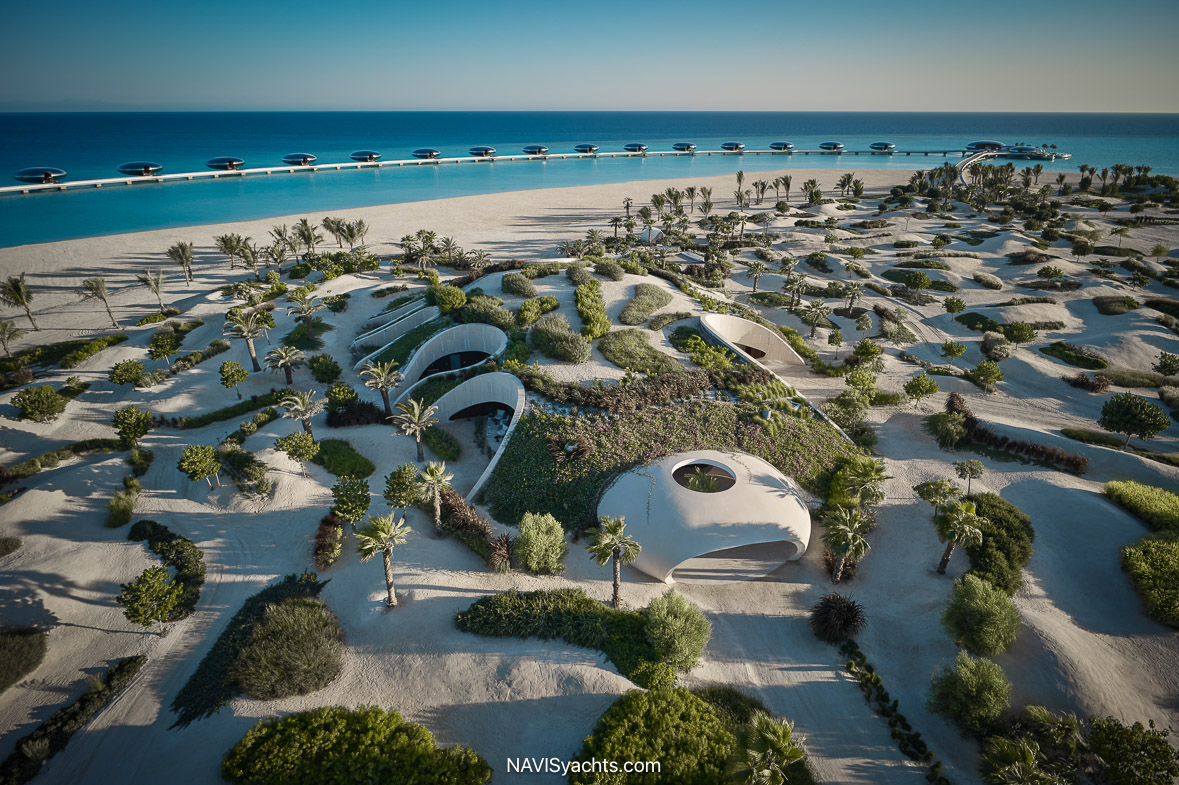
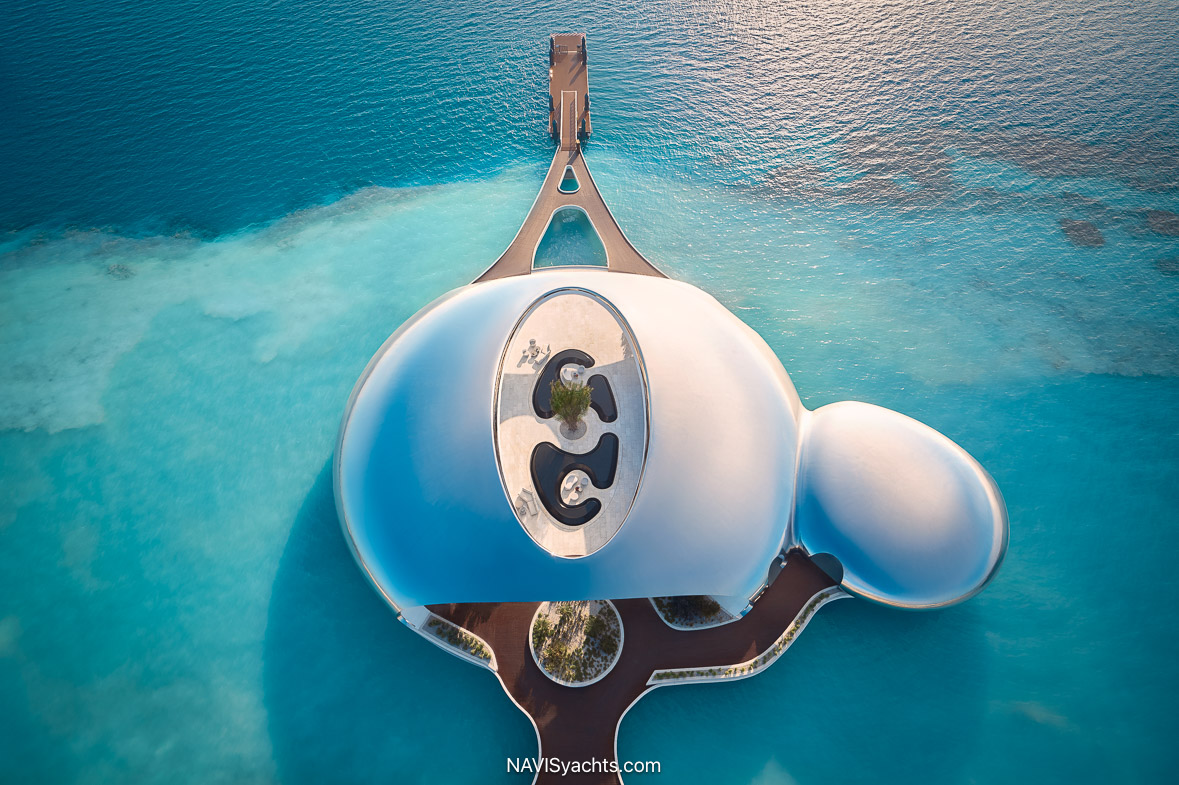
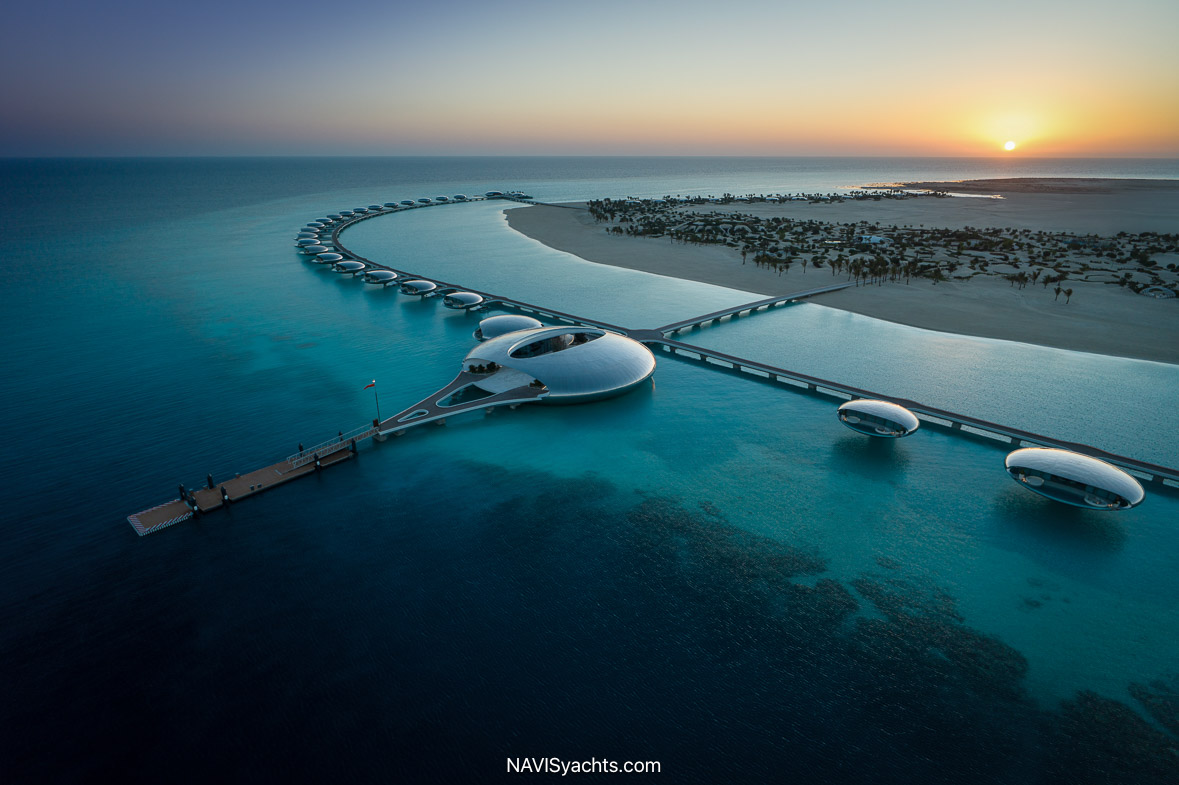
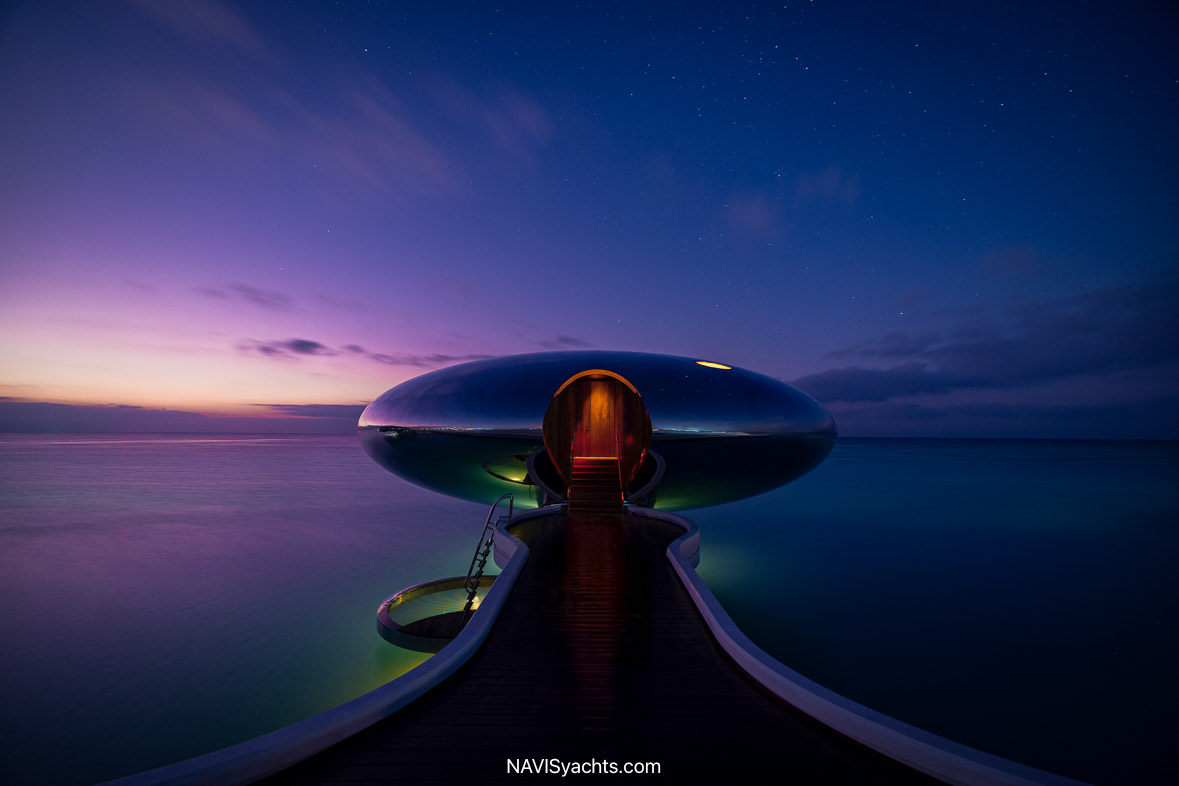
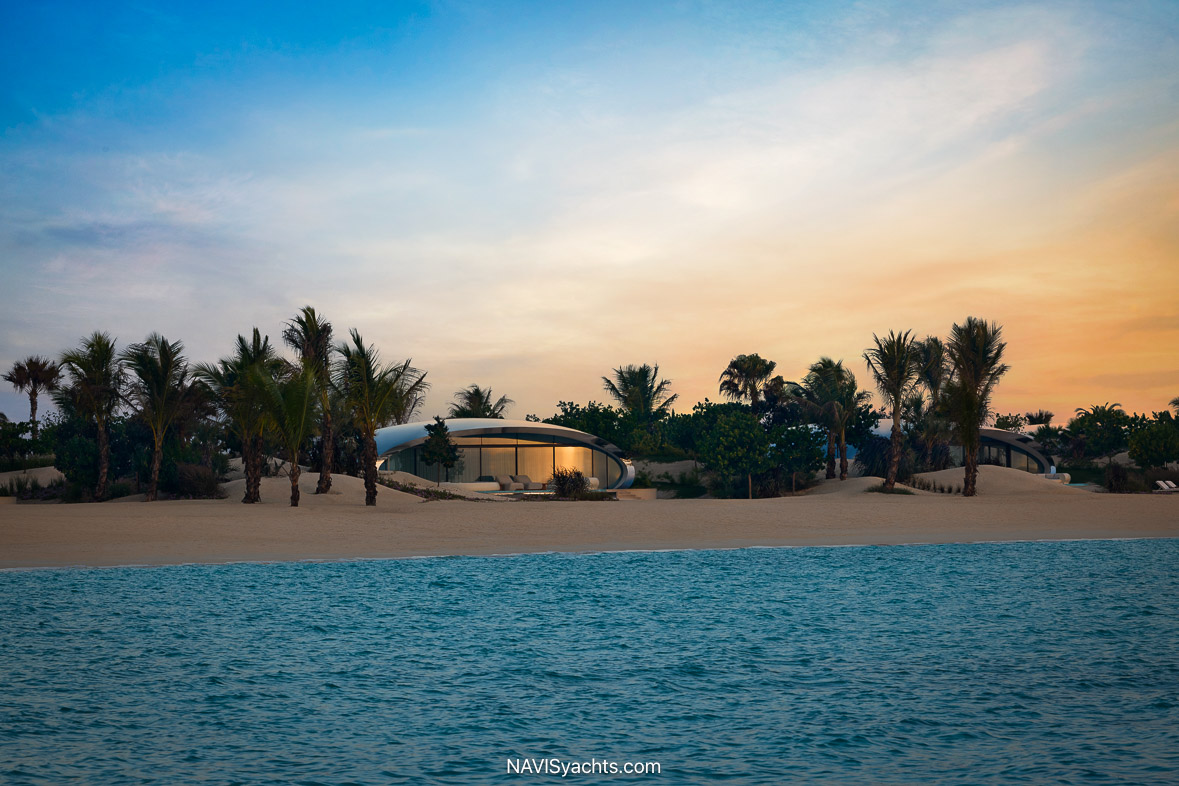
A first glimpse of Shebara Resort typically emerges out over the Al Wajh lagoon in Saudi Arabia, some 500 km (360 mi) north of Jeddah. Ten or twelve minutes into the boat transfer, a long necklace of mirrored ovals appears, shimmering in the heat of the day. From a seaplane window, half an hour out of Red Sea International Airport, the effect is different but equally arresting: a curving chain of stainless-steel pods stitched into the turquoise of the Kingdom’s Red Sea, set against a silken beach of sand so pale it looks bleached.
Shebara, which opened to its first guests in late 2024 as the first ultra-luxe Red Sea Global-operated property within the Kingdom’s flagship destination, has been engineered for exactly this kind of optical theater, especially as its 1,760 km of pristine Red Sea coast features strongly in the ambitious Vision 2030 plan. Within its first months in operation, TIME Magazine named it to its 2025 World’s Greatest Places list, a recognition that, more than nightly rates, signals where the property is being positioned.
The Design
The resort’s architecture is the work of Killa Design, the Dubai-based studio that announced itself on the world stage in 2015 by winning the international competition for what would become Dubai’s Museum of the Future, the pillar-less calligraphic torus across Sheikh Zayed Road that has become one of the most photographed and architecturally lauded structures in the Gulf.
The design for Shebara is equally iconic and arresting. Beyond the visual register is an engineering brief without precedent in hospitality. To preserve the reef and the seabed, every villa was prefabricated, fully fitted, and commissioned offshore at a yard on the mainland, then floated out and essentially plugged into a solar-powered infrastructure featuring engineering tech that has never before been used in a hospitality setting.
Sheybayra Island, the resort’s home, is a previously undeveloped island prized for its coral, its turtle populations, and the quality of its uninterrupted reef. It is but one of an archipelago of 92 islets within Al Whajh lagoon, a pristine 2,081 km2 (803 mi²) area of precious natural habitats including coral reefs, seagrass, and lush mangroves hosting diverse species of global conservation importance. The on-island solar farm supplies the entirety of the property’s electrical load, including desalination, cooling, lighting and transport, and guests are invited to walk and cycle through it rather than have it concealed behind a service wall. Operating as a zero-energy, zero-water, zero-waste resort, Shebara is setting new benchmarks for sustainable eco-tourism and purposefully incorporating that sustainability into the guest experience.
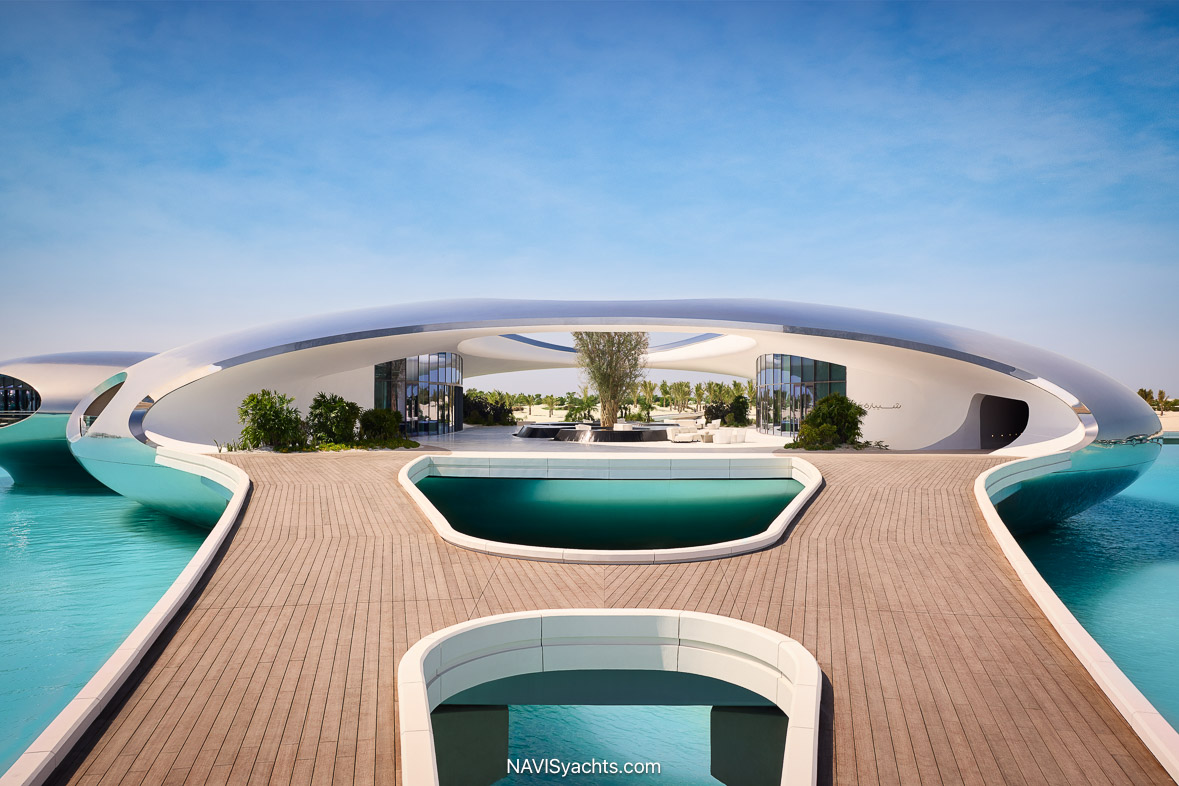
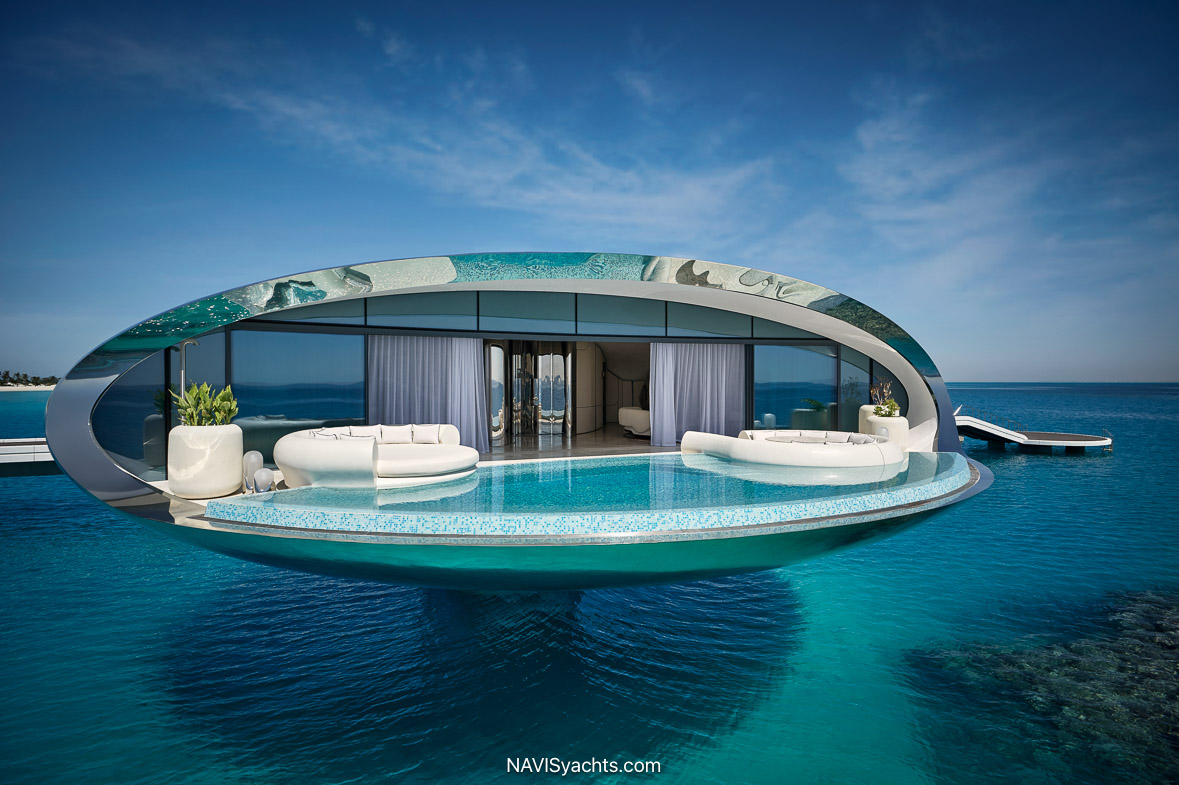
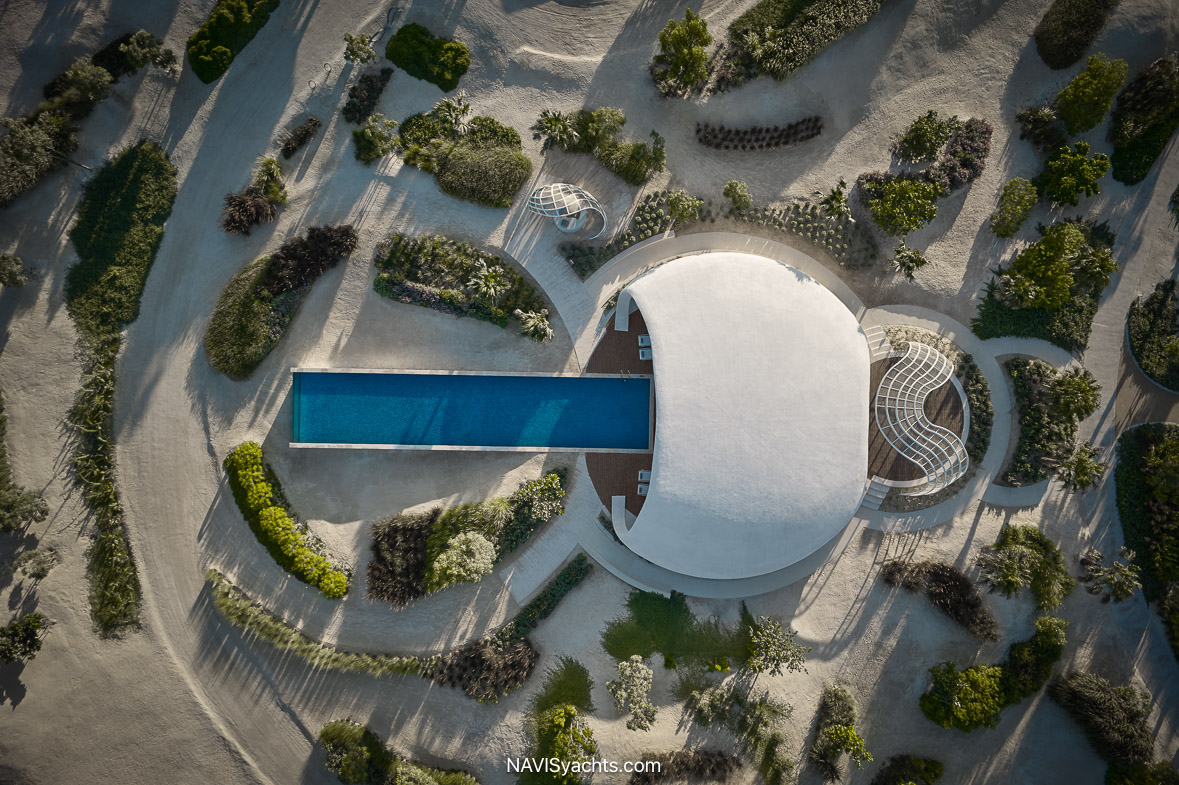
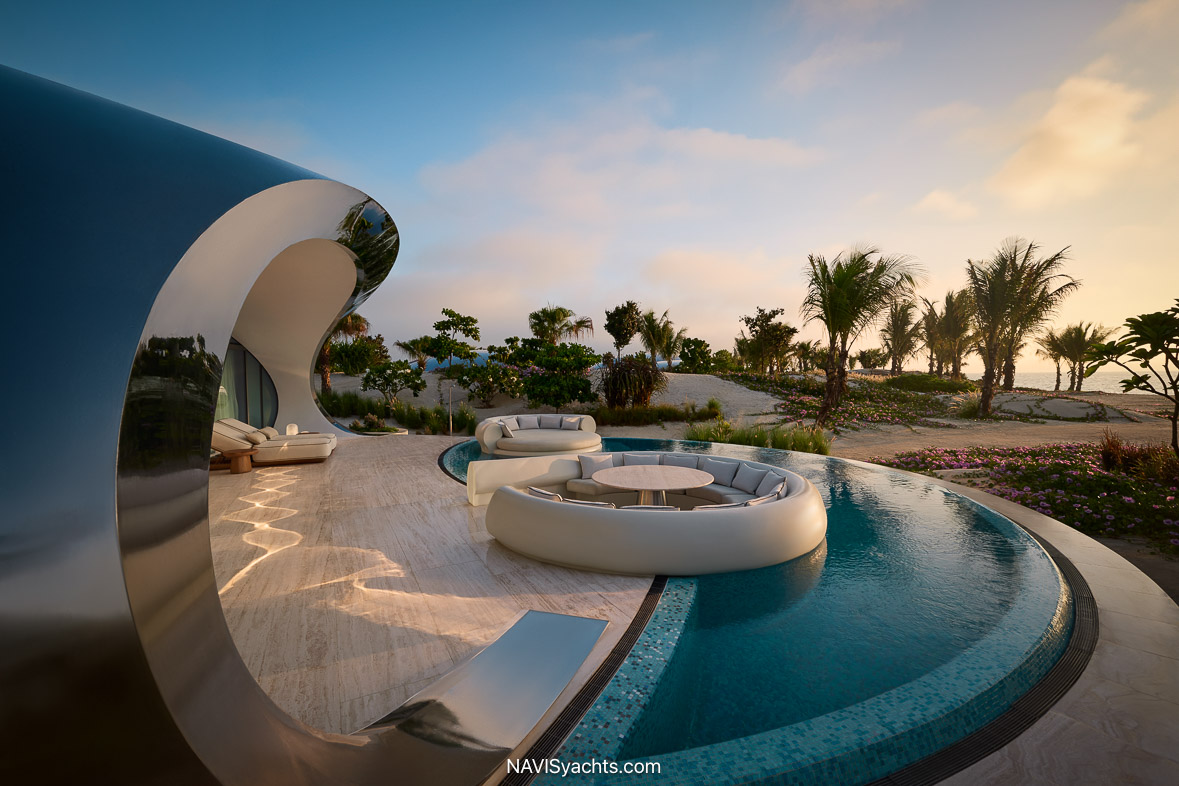
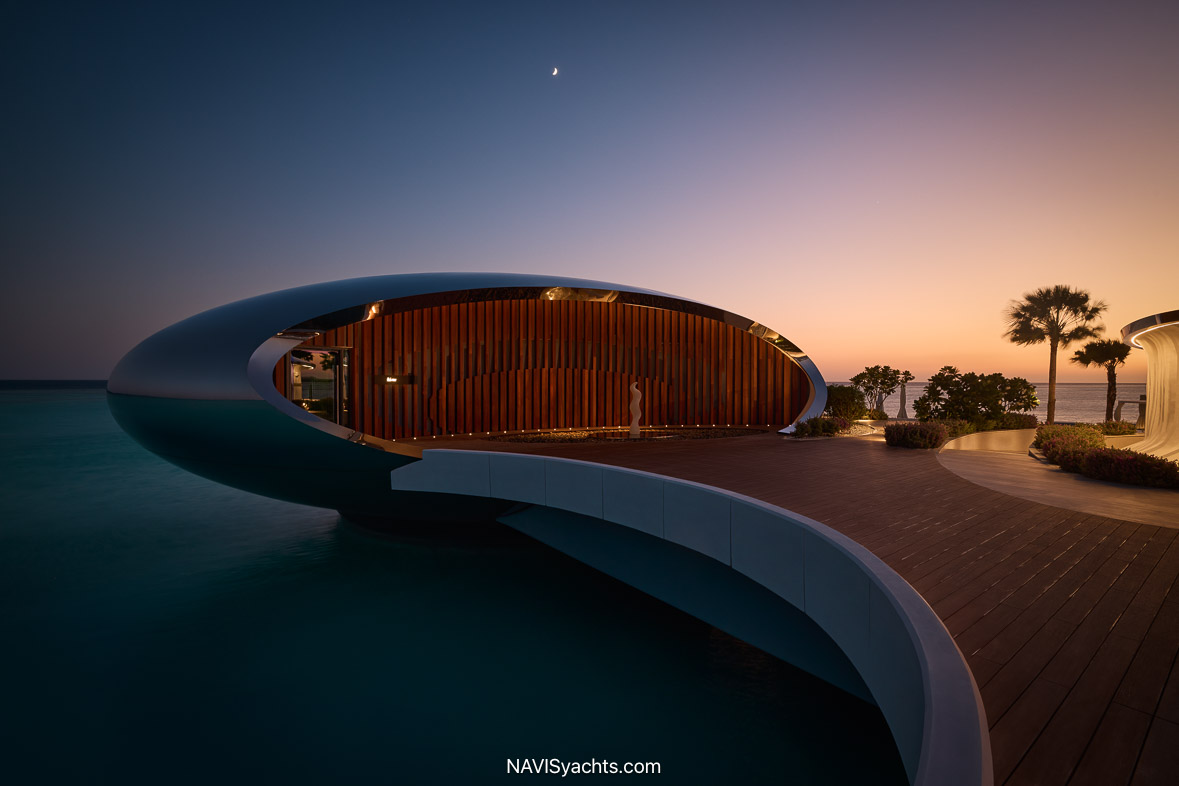
Equally theatrical and disciplined, the 73 stainless-steel orbs are distributed between a curving over-water spine and an arc of beach pods, each clad in mirror-polished steel. The lower hemispheres reflecting sea or sand, the upper hemispheres returning sky, and the equatorial seam between them dissolving the silhouette into whatever weather happens to pass. At dawn the villas glow rose; by midday they vanish into the lagoon’s turquoise; at dusk they take on the carbon-blue of the deeper water and seem to hover. And while the immediate default is a mid-century modern vision of future space travel, the oft-termed UFO Hotel this is not: the intent is far more organic and terrestrial, with each pod mimicking bubbles rising from the depths.
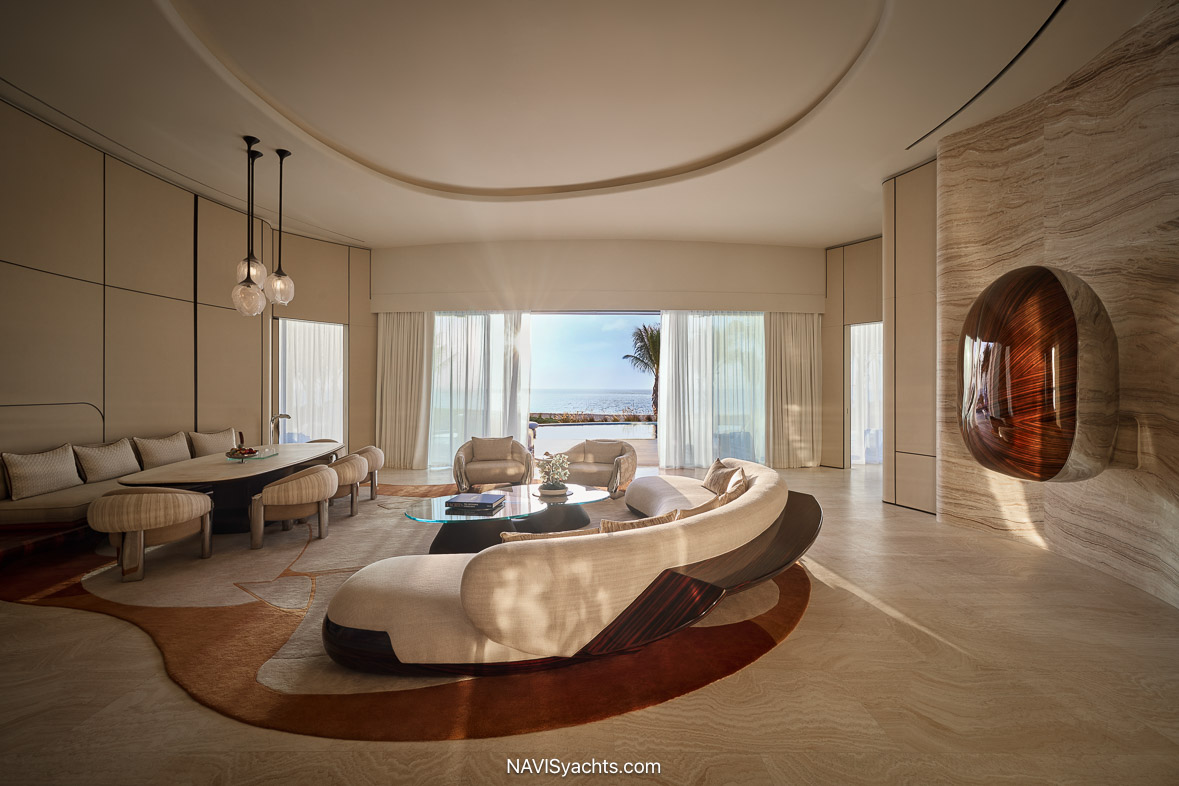
Within those pods, the sensibility shifts entirely. Studio Paolo Ferrari, the Toronto-based practice known for its work for a roster of high-design hospitality clients, penned the interiors.
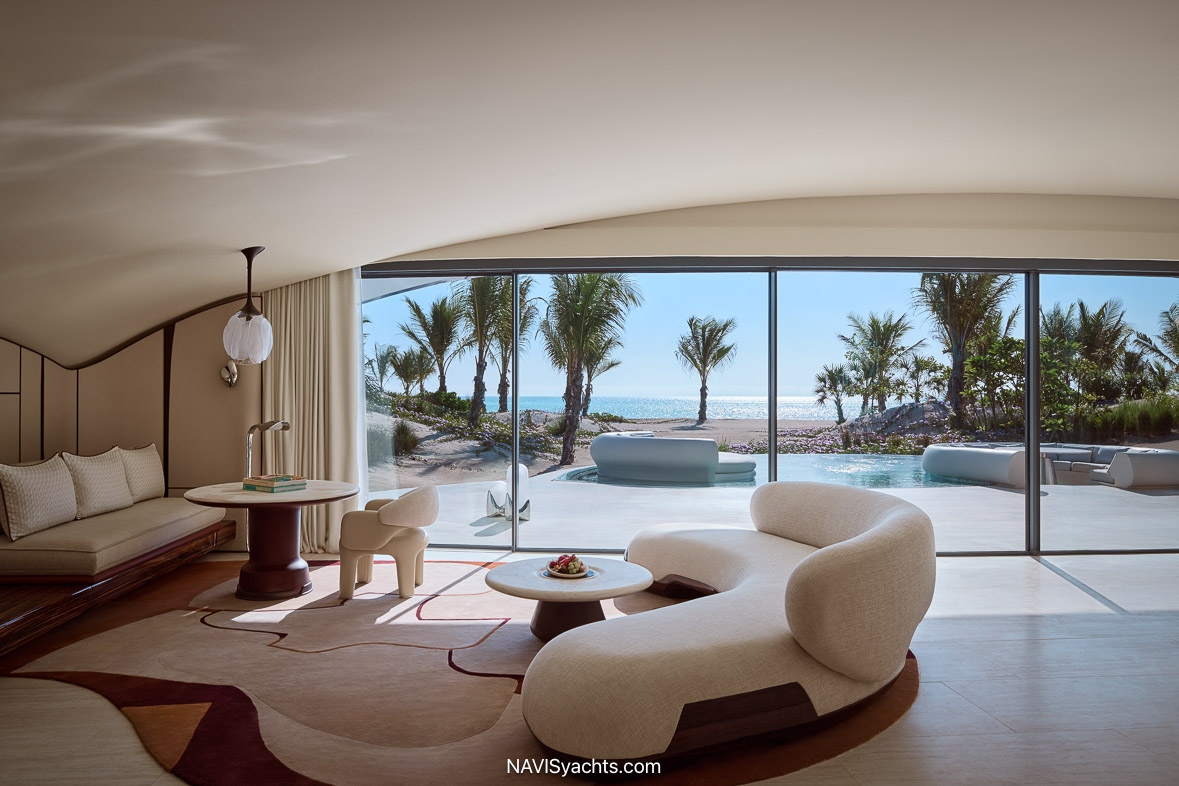
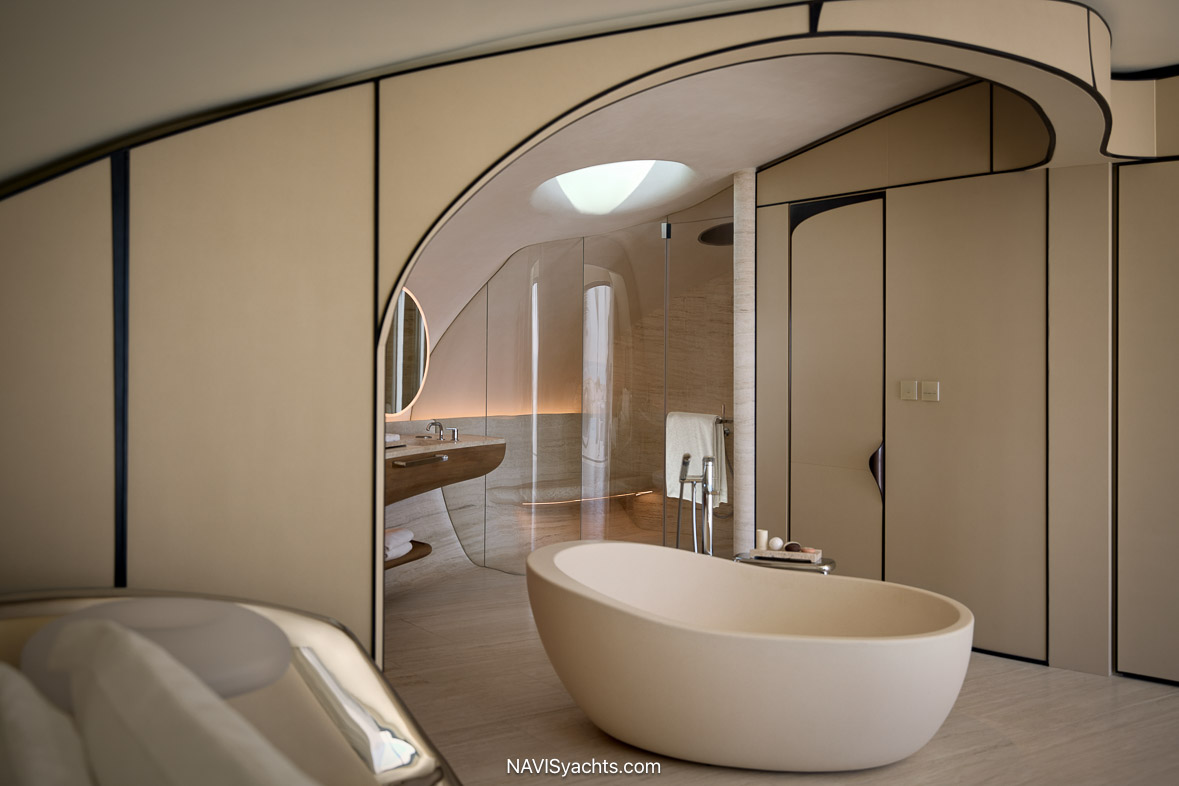
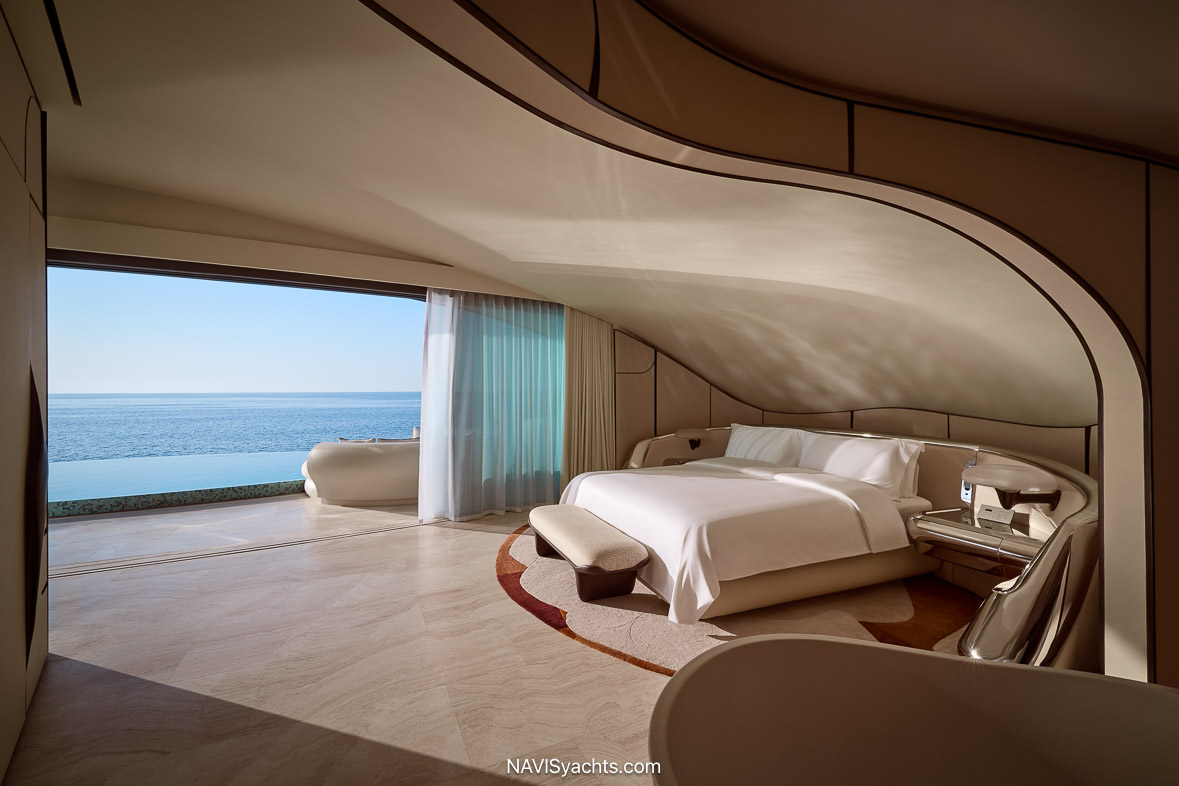
If these resemble those of yachts or private aviation, you’d be on target with disciplines in which curvature, headroom and millimeter-level clearance are negotiated in three dimensions, and in which every square inch is achieved with effort to look seamless. The team modelled each villa interior in 3D and built around the orb’s geometry rather than against it, resulting in a cossetting dearth of right angles.
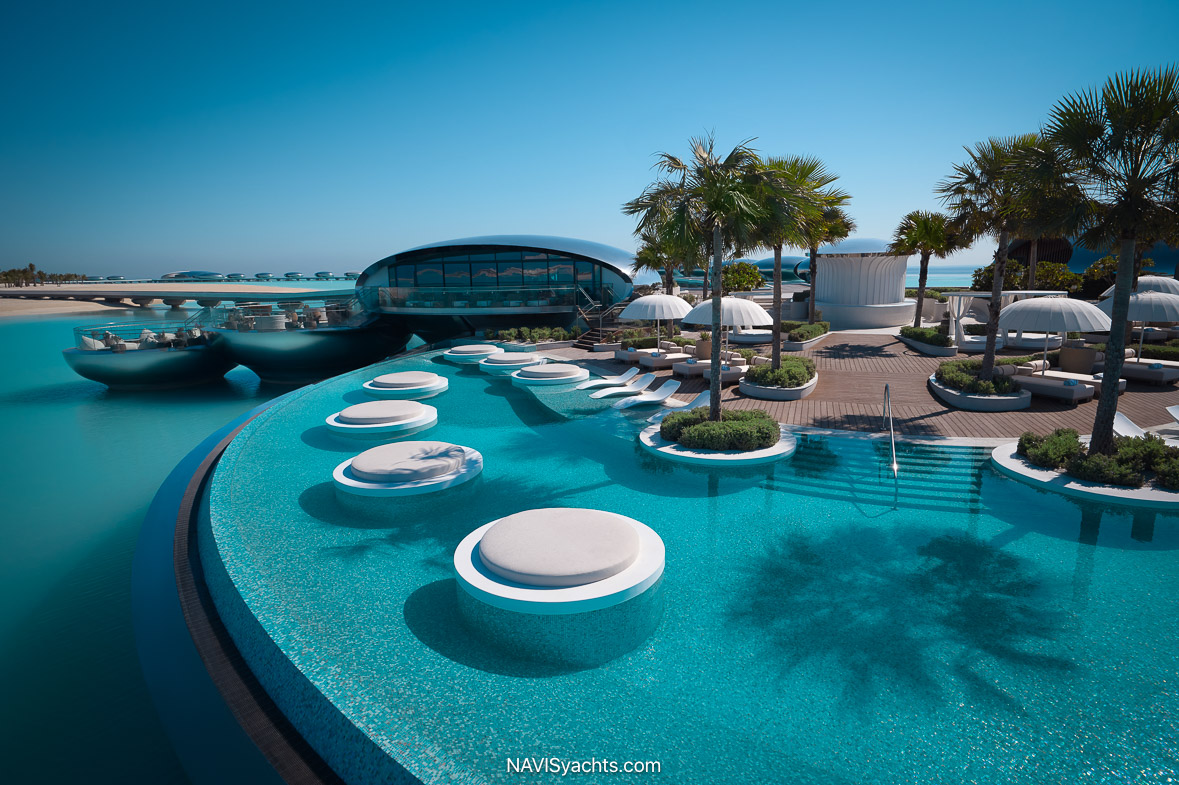
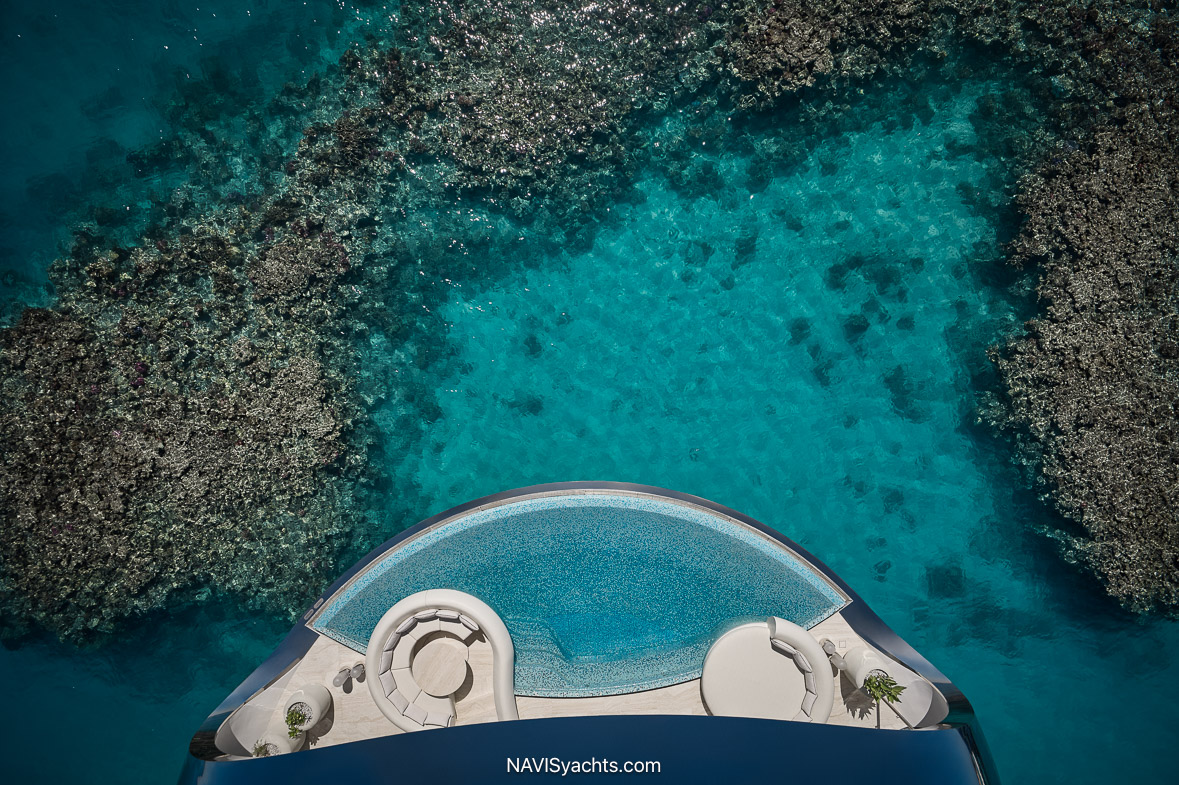
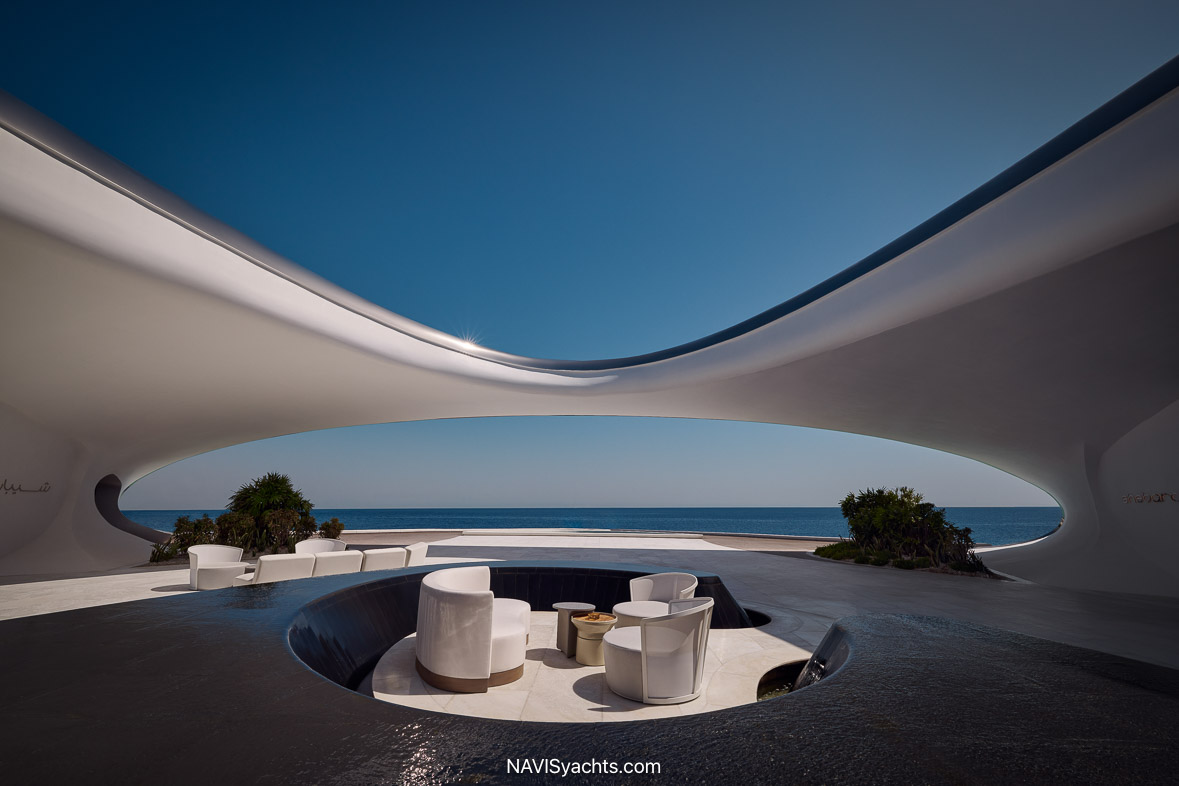
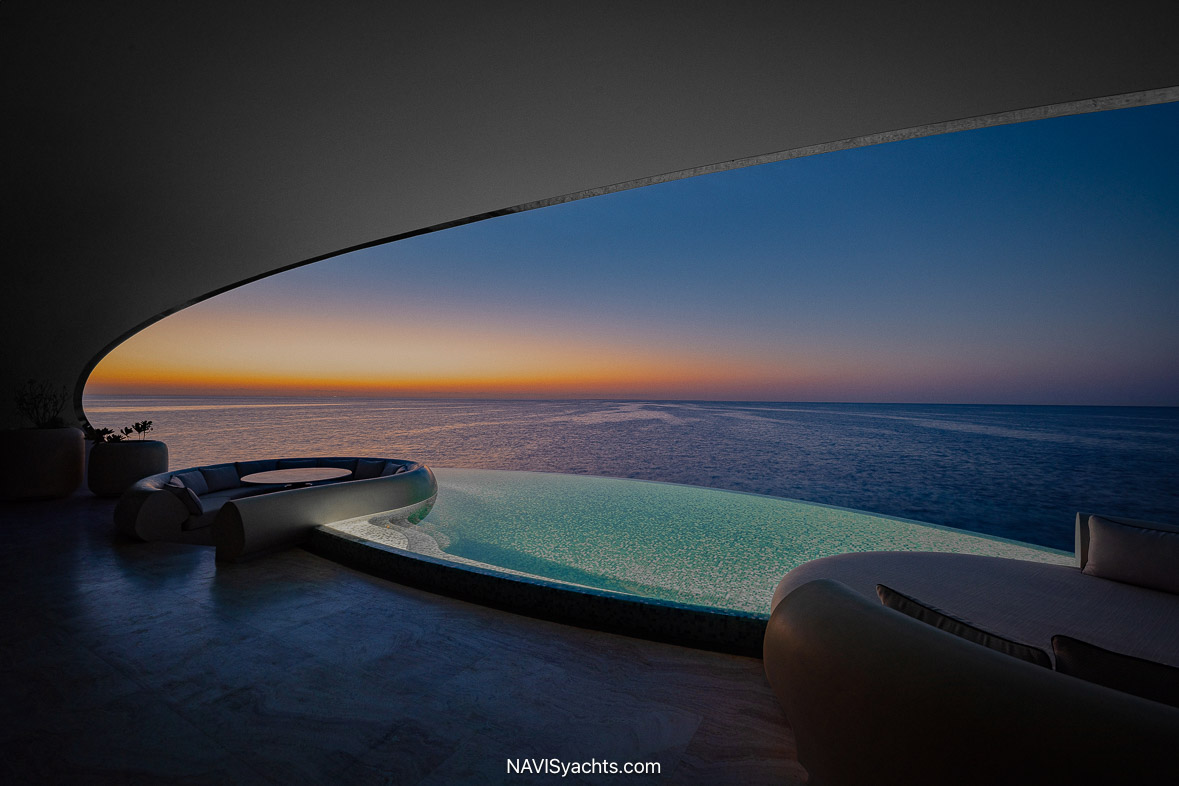
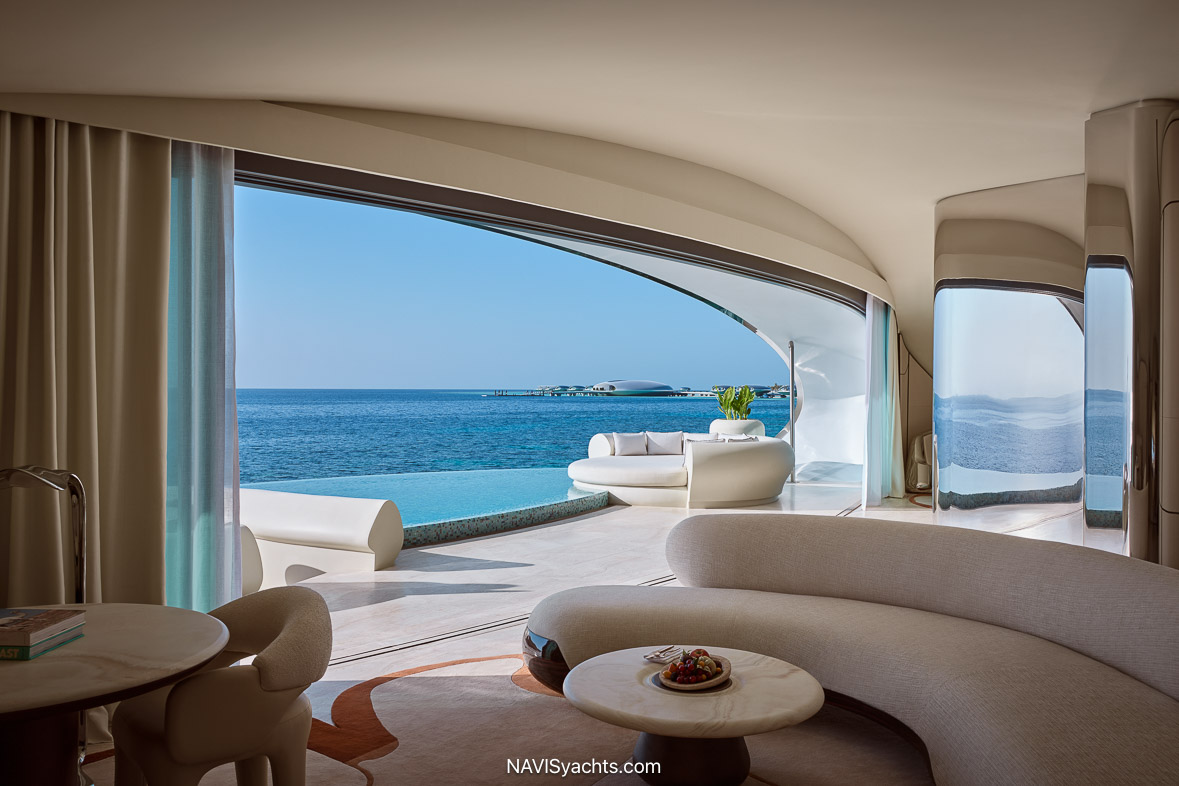
The material palette is restrained and very tactile: cast glass, travertine, oak, walls of hand-stitched leather, and brushed metalwork. Views defer to the water, as nature, and not design, is the star here; the curved glass walls retract at the touch of a button to open the living room directly onto an infinity pool, a sunken outdoor lounge and the Red Sea horizon in one continuous line. Lights, air-conditioning and patio doors are all touch-screen controlled.
Entry level accommodations are quite spacious, begin at the 188 m² (2026 ft²) One-Bedroom Overwater Villas (33 keys) and the 248 m² (2670 ft²) One-Bedroom Beachfront Villas (17 keys), each anchored by an infinity pool, a sunken outdoor lounge and a double daybed. These are followed by five Two-Bedroom Overwater Villas and ten Two-Bedroom Beachfronts. At the top of the house, The Beachfront Royal Villa Ensemble sits on a separate islet altogether, anchored by a 900 m² (9,688 ft²) four-bedroom Royal Villa with study, media room, BBQ deck and staff quarters, surrounded by three one-bedroom villas, and reached by its own private yacht dock.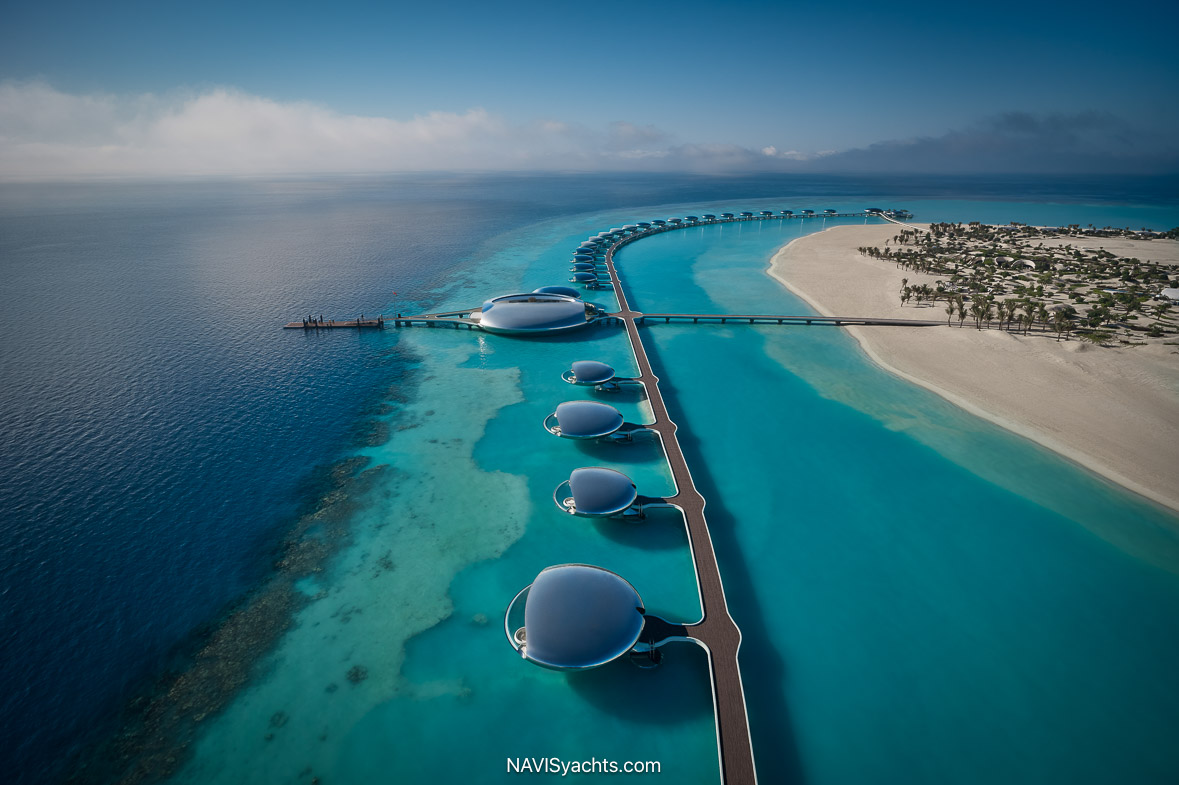
On the Water
The pristine waters of the Red Sea have been a closely held paradise for divers. These are some of the world’s best locations for both snorkelling and diving due to its wealth of rich corals, diverse dive sites, and abundant sea life. Al Wajh Lagoon is among the least-trafficked stretches of reef anywhere, and the house reef in places begins a few strokes from the villas’ terraces. Above the water, the sailing program is the headliner. Catamaran sailing is offered daily under an international instructor team for a range of guests, from absolute-beginner introductions to advanced clinics. For groups travelling with their own yacht or chartered crew, the Royal Villa Ensemble’s private dock is the standout proposition: tenders, RIBs, and with advance coordination, larger vessels can deliver guests directly to the villa rather than via the central jetty.
Transparent crystal and traditional kayaks, paddleboards, sea-bobs and windsurfers are all on offer and there is a full electric stable: E-SUPs, E-foils, E-foil scooters, E-surfboards and E-bodyboards as well as wakeboarding and wakesurfing pulled behind the resort’s E-boat.
Below the surface, there is a PADI menu for all levels: Bubble Maker sessions for young ones, Discover Scuba Diving and Open Water for beginners, and Advanced Open Water, Rescue Diver and specialty courses for the more experienced. Night snorkels are timed to coincide with the bioluminescent bloom.
The Spa
The Spa at Shebara was given to NYC-based Rockwell Group, the same hand responsible for the property’s restaurants, and the architectural register softens deliberately here. Earth tones, layered grain, a procession through arched corridors that read more grotto than gallery. The facility itself comprises five indoor treatment rooms, three outdoor cabanas, an outdoor vitality pool, separate his-and-hers circuits of Jacuzzi, steam and sauna, and full salons for men and women. The products line is small and deliberate as well: the British luxury skincare line AMRA anchors most of the signature treatments. The other house represented is the Swiss skincare laboratory Dr. Burgener. Beyond the treatment menu, a dedicated yoga pavilion runs both traditional and aerial classes, and the 24-hour fitness center features on-site personal trainers.
The Tables
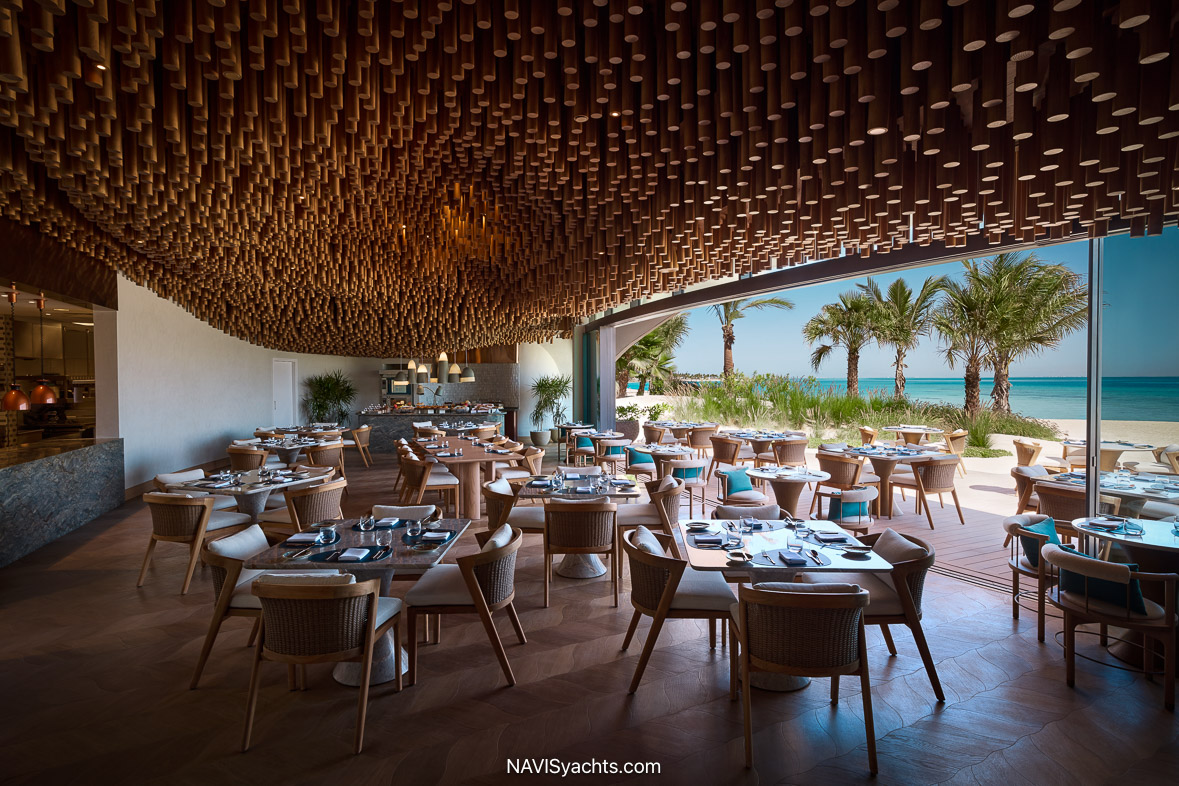
Rockwell Group crafted Shebara’s five restaurants and bars with reef-inspired motifs running through the interior detailing, including coral filaments, undulating ceilings, with colors drawn from the marine palette.
iki.roe, features an open-kitchen for its menu of Japanese-Peruvian fusion cuisine. A dedicated omakase counter is also on offer, as well as a sea-facing terrace for capturing the sunsets.
Ariamare, the Mediterranean restaurant, is helmed by Michelin-starred chef Marco Garfagnini. The glass-walled Pasta Lab is where the day’s raviolini and tortelli are rolled and cut in the room. The sea-facing terrace is the property’s premier sunset-dinner option.
Lunara, the international brasserie, is the breakfast and all-day room featuring a long view of the lagoon. Saria, the Family Pool Bar and Grill, serves Levantine cuisine beachside. Solera, the adults-only sunset bar, is the most architecturally distinct of the venues: a deliberately cinematic perch on the western edge of the property, with a non-alcoholic mocktail program built around Red Sea and desert botanicals. The Kingdom is a dry destination, but for many Solera will be the easiest place on the resort to lose two hours to the horizon.
Style and Substance
For those already familiar with the Maldivian over-water archetype, Shebara is a different proposition entirely, closer in spirit to the early days of Amanresorts, where the architecture was the experience and the rest of the operation existed to frame it. The Red Sea is cooler, clearer and more biodiverse than its Indian Ocean equivalents; the season is longer; the runway from Europe is shorter; and the building itself, on any reasonable metric, is the most ambitious piece of resort architecture to open anywhere in the world, in this decade at least, reflecting The Red Sea Global’s ambition to become an extraordinary regenerative destination for the world. Shebara is, in short, worth seeing, preferably soon, and preferably with one’s own boat.
Photos: Shebara Resort Media - Words: Janine Devine