There’s a strange kind of silence that follows a car like this. Not because it’s electric— it isn’t —but because Brouillard doesn’t need noise to get your attention. It just is.
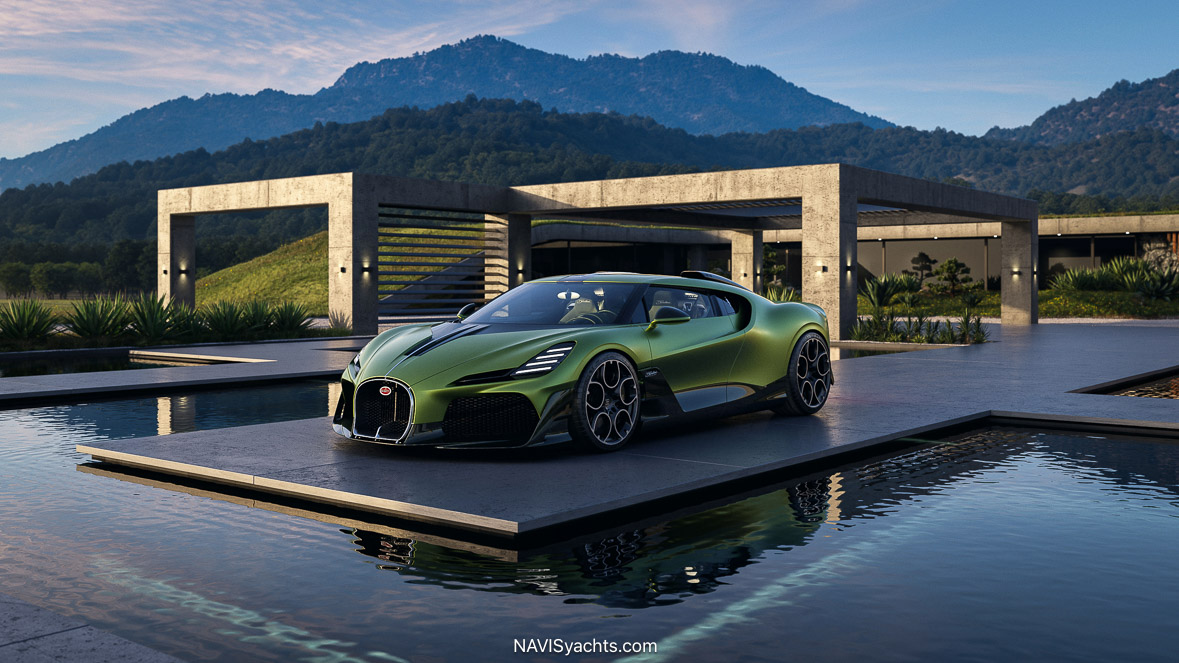
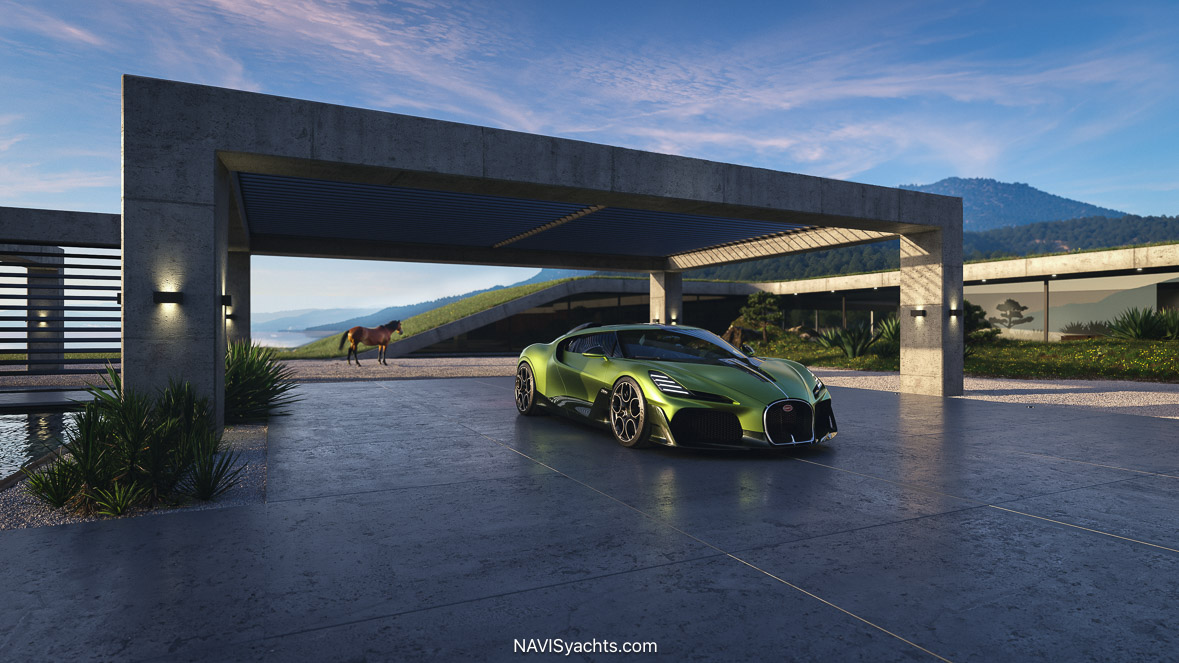
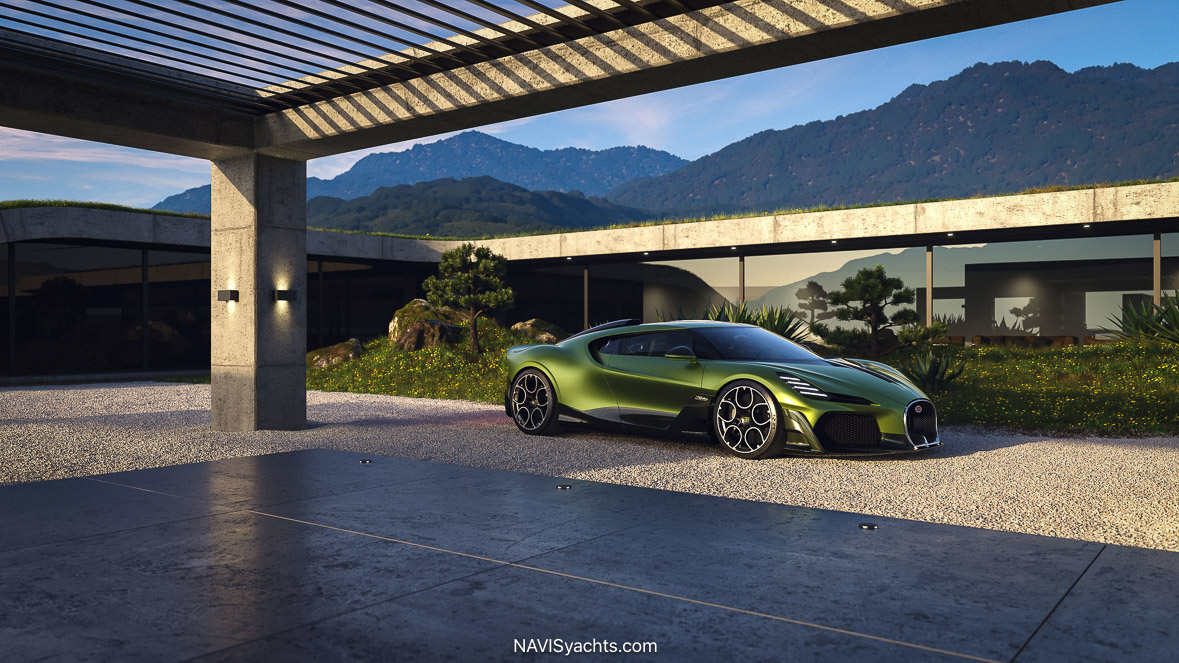
Sitting low against a gravel courtyard, still warm from a short morning idle, the coupe looks like someone sculpted a wisp of green mist and stretched it across four meters of carbon fiber. Even the name, Brouillard, French for “fog”, feels more atmospheric than automotive.
This is the first creation under Bugatti’s new Programme Solitaire, a coach-building initiative that goes beyond Sur Mesure and lands somewhere between sculpture, obsession, and ancestry. Two cars a year. One-of-ones only. Each built not just to the client’s specification, but around an idea, a story, a memory.
In this case, that story begins with a horse, Ettore Bugatti’s personal companion, one so beloved he designed a mechanism for it to open its own stable door. That connection between living form and engineered object isn’t just lore here. It’s visible. The car’s surfaces flow with the same tension as a trained thoroughbred, muscle beneath calm, velocity without motion. You don’t see lines so much as the suggestion of movement.
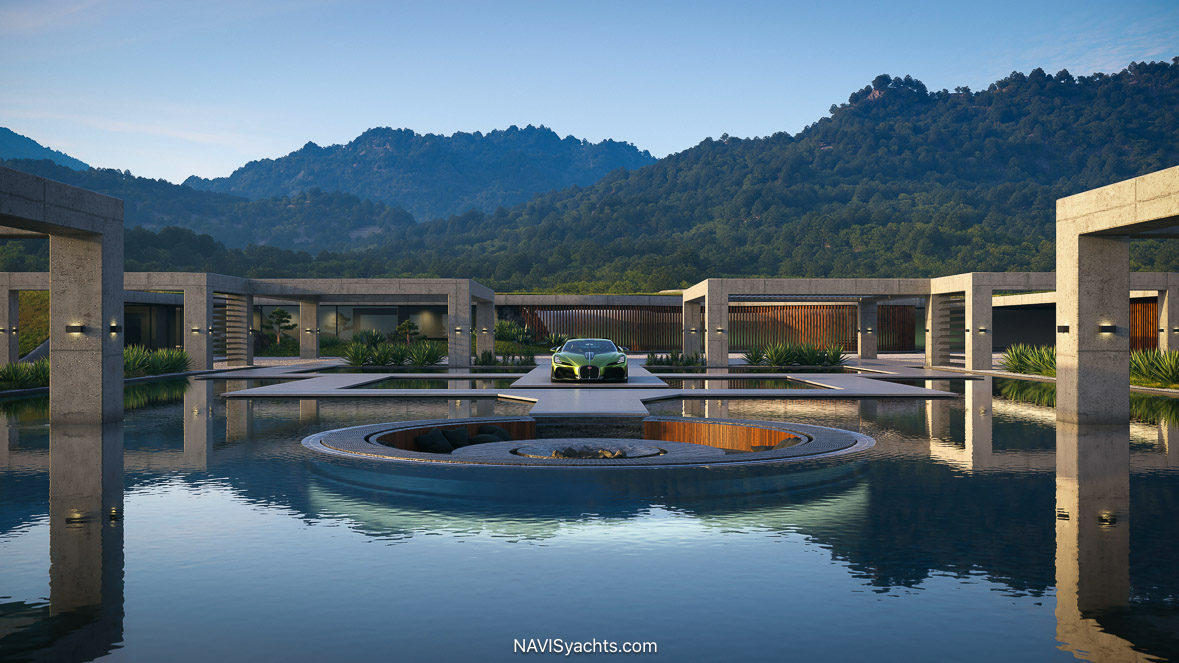
And the weirdest part? It doesn’t feel like it’s showing off. It’s not surrounded by a velvet rope, nor is it idling on a rotating stand under a spotlight. It’s just here, grounded, as if it belongs outside a home built into the side of a mountain. As if 1,600 PS is simply how you go pick up bread.
The Shape of a Statement
You can’t rush the walkaround. Brouillard isn’t the kind of car you glance at and move on from. Every step reveals a shift in form, a surface you hadn’t noticed, a reflection you weren’t expecting. And that’s the whole point. This car was shaped like an industrial design study left in the wind tunnel long enough to become myth.
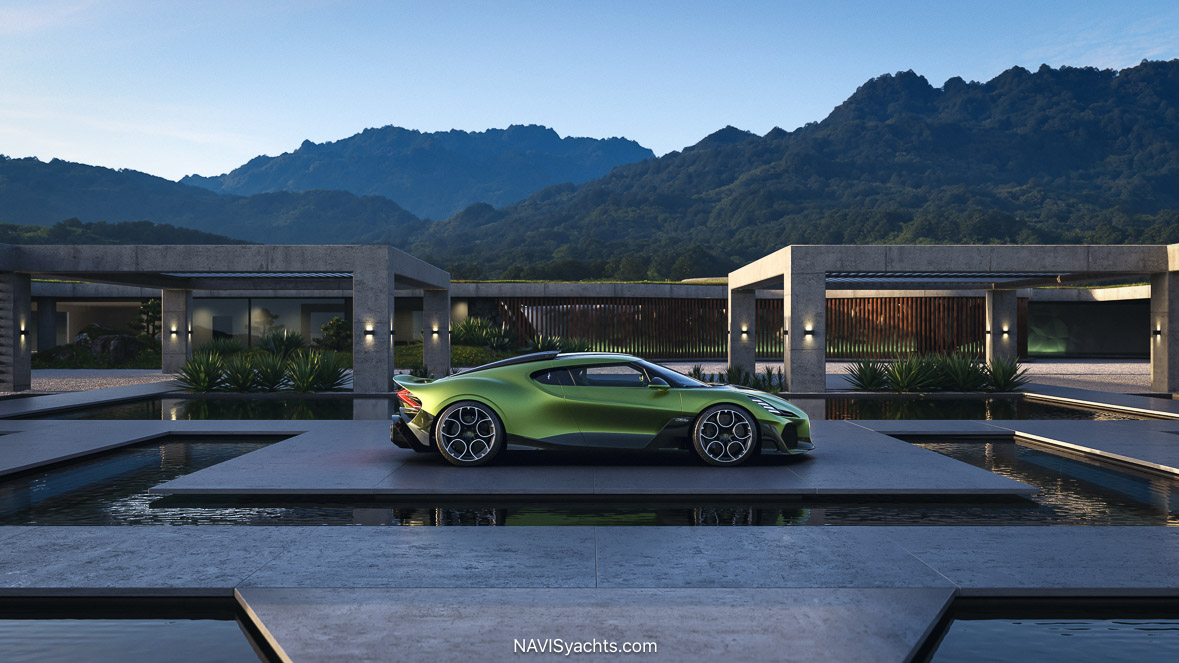
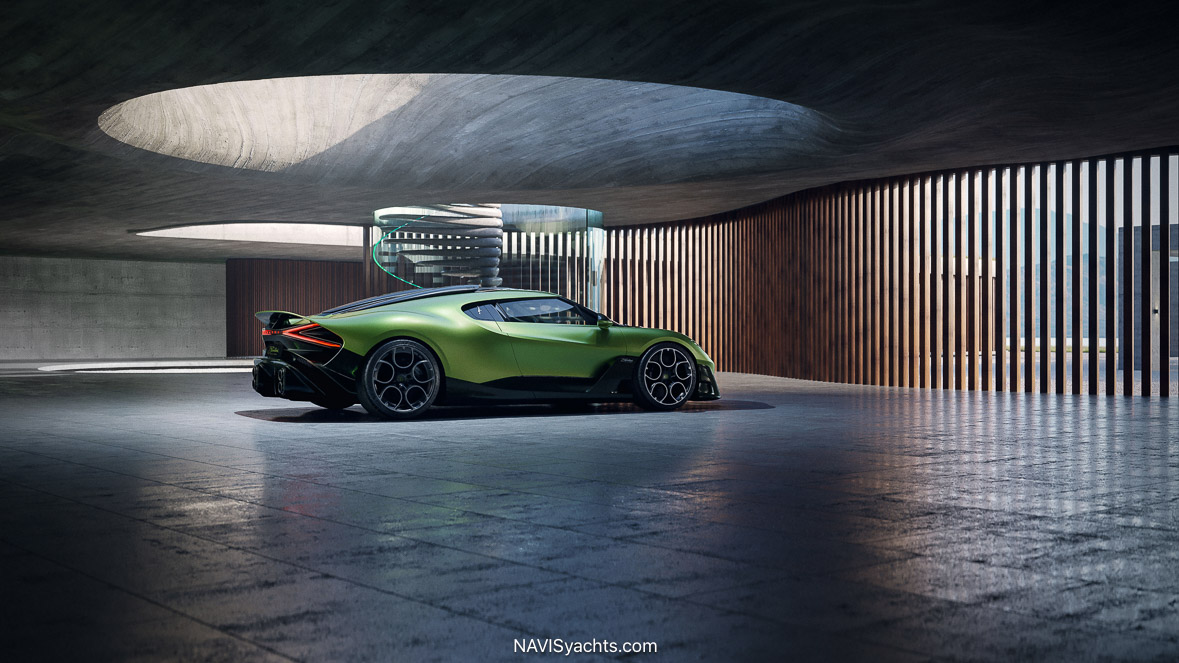
Bugatti’s lead designer calls it a horse’s muscle under skin, and you get that immediately from the side. The absence of creases lets your eyes follow uninterrupted curves from the front splitter through the door scallop and into the rear haunch, where the tension gathers like a coiled tendon. It’s anatomical. The lower body, draped in shadow-dark carbon, tucks in visually like a racehorse’s legs before launch, while the upper half carries the full weight of the paint, a subtle, metallic green that changes character in different light.
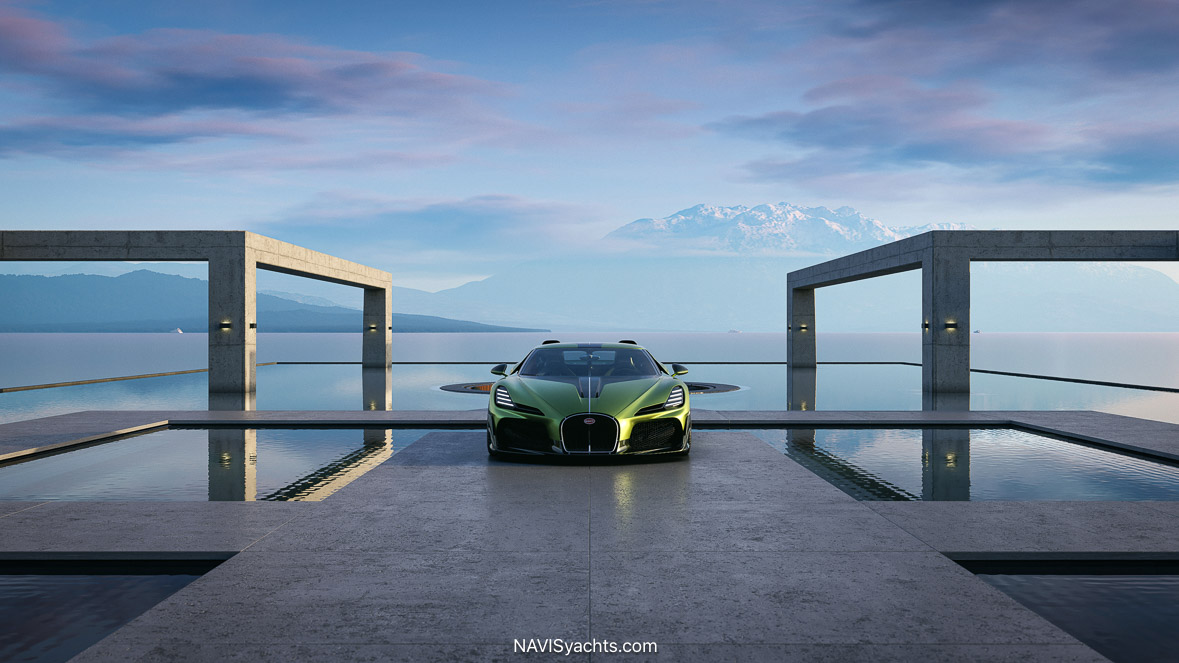
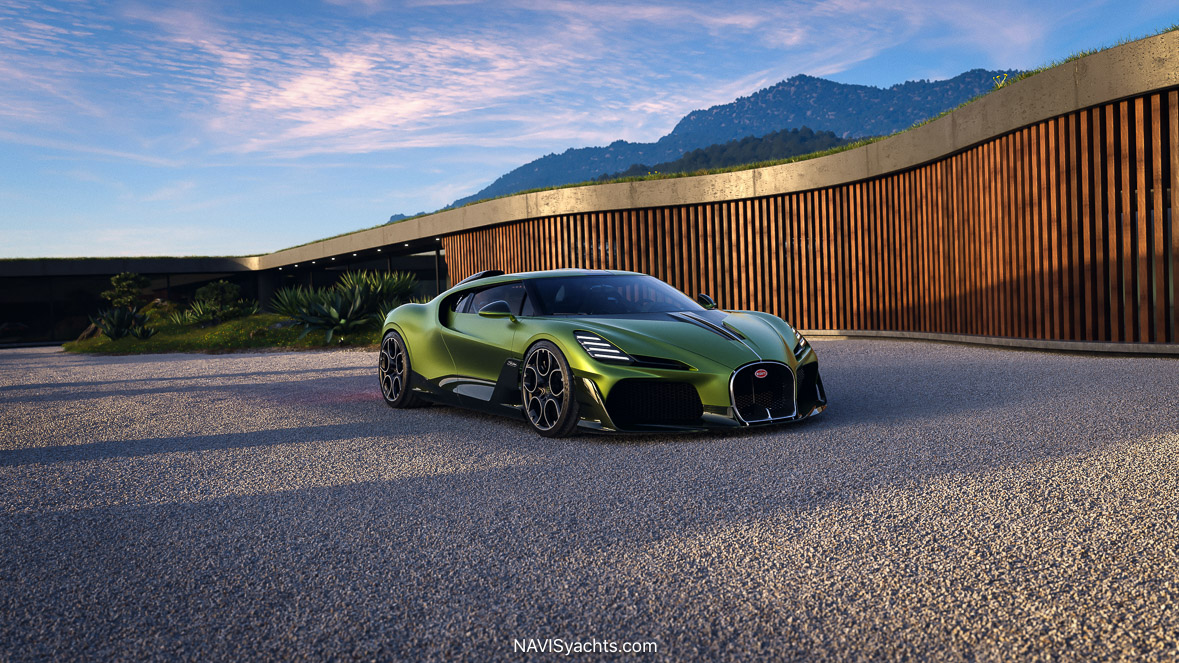
From the front, you get a clearer look at how Brouillard distills aggression into symmetry. The horseshoe grille remains the anchor, but the vertical draw down the hood, framed by those deeply scalloped aero channels, turns the entire fascia into a three-dimensional sculpture. The headlights, stacked horizontally like a pianist’s hand caught in mid-arpeggio, suggest precision instead of menace. There’s nothing decorative about them. Every edge has been resolved to reflect purpose.
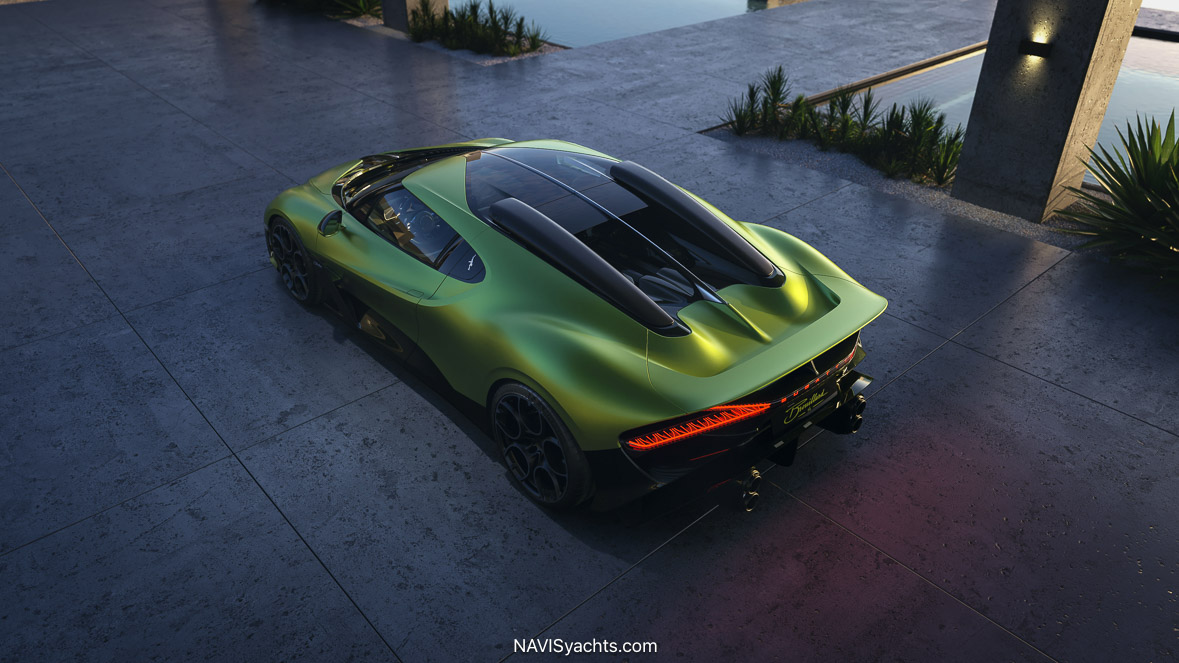
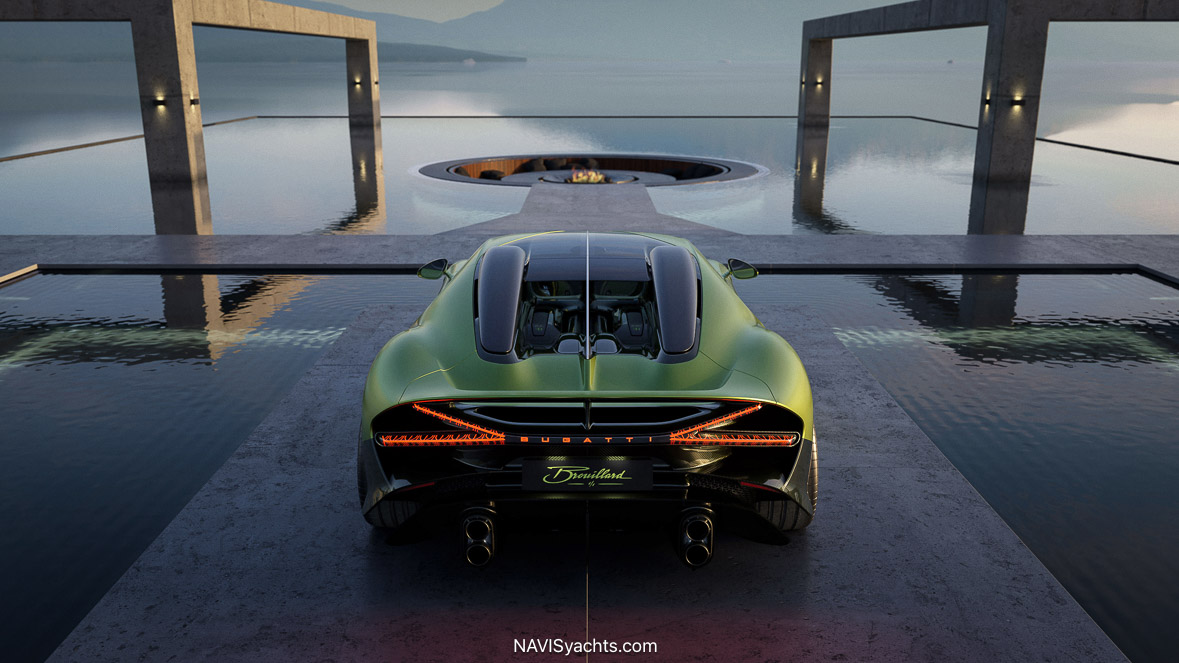
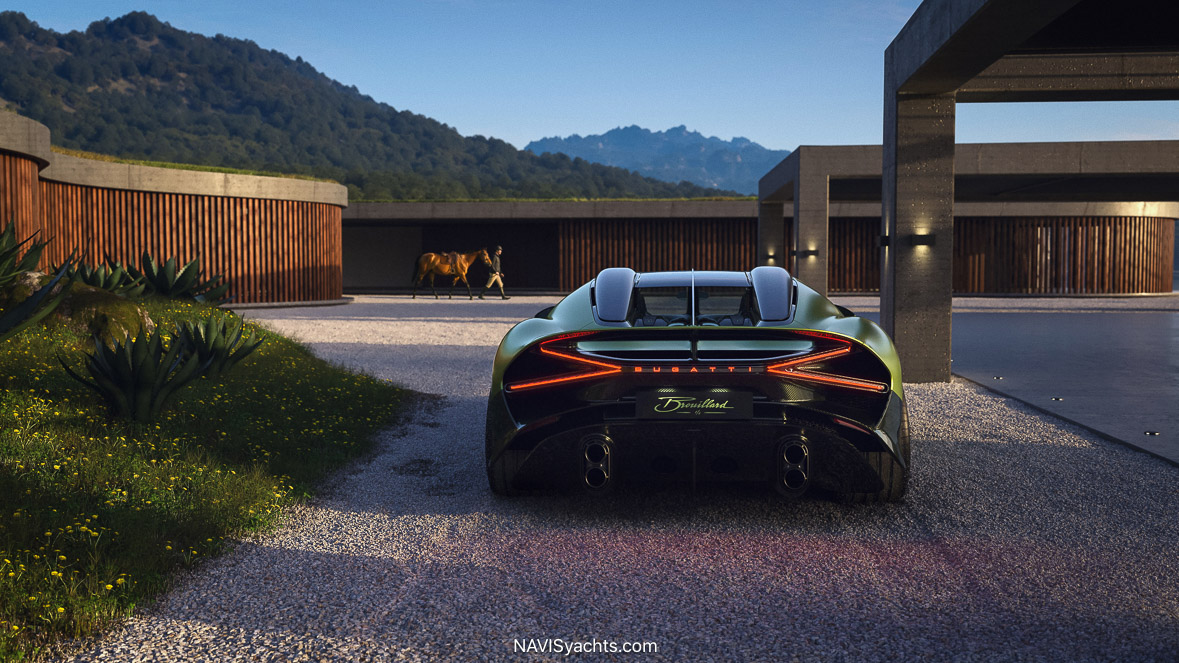
The rear design is another level of commitment. Two wide-set exhaust exits balance the massive rear diffuser, while a single red light blade zigzags across the back like a signature you only catch once the car is gone. And above that, a fixed ducktail spoiler finishes the form, not tacked on, but integrated, like the trailing edge of a feathered wing. You notice how the roofline tapers into a sharp crease that drops between the nacelles, a detail that plays visually with the engine’s centerline and the car’s aerodynamic balance.
On screen or in photos, Brouillard might look compact. In person, it has presence. Those massive wheels, custom-milled, floating five-spoke patterns with etched accents, fill the arches cleanly, giving the car a planted stance without looking forced. And yet, because the roof is visually separated by the gloss-black carbon spine, the car seems to sit lower than it actually does. It cheats your sense of height, a trick of proportion and color blocking that shows just how far Bugatti has come since the Veyron years.
Open the door, and the exterior’s restraint continues inward. The cabin carries the language forward, just with different materials.
Heart, Brain, and Voice
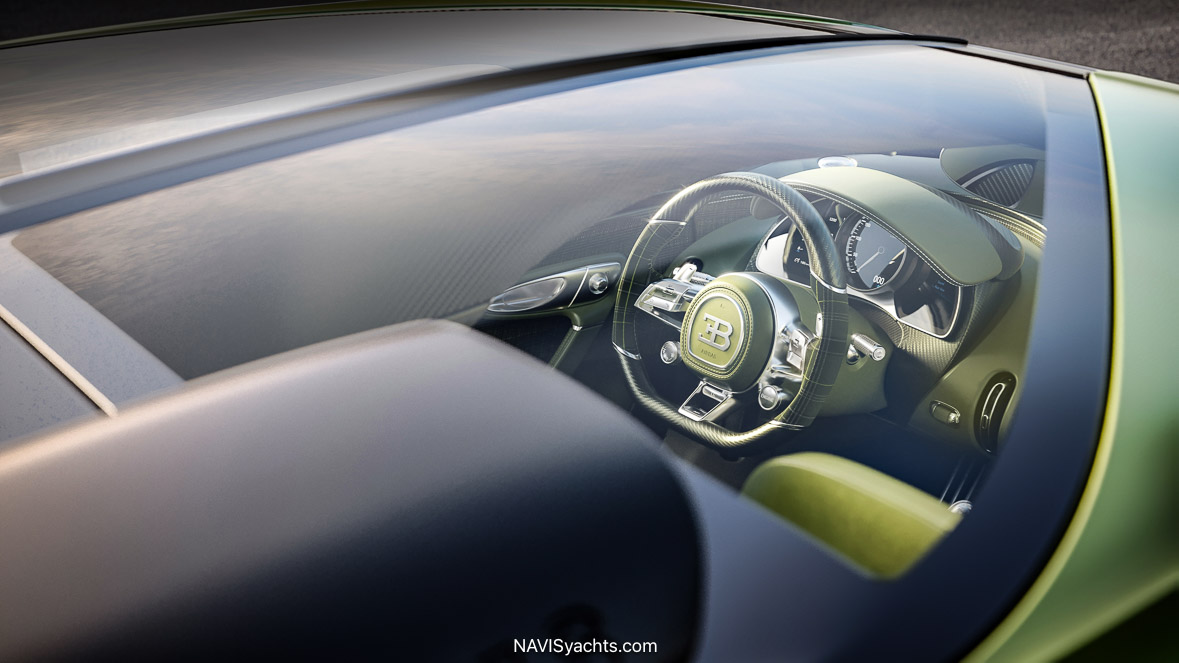
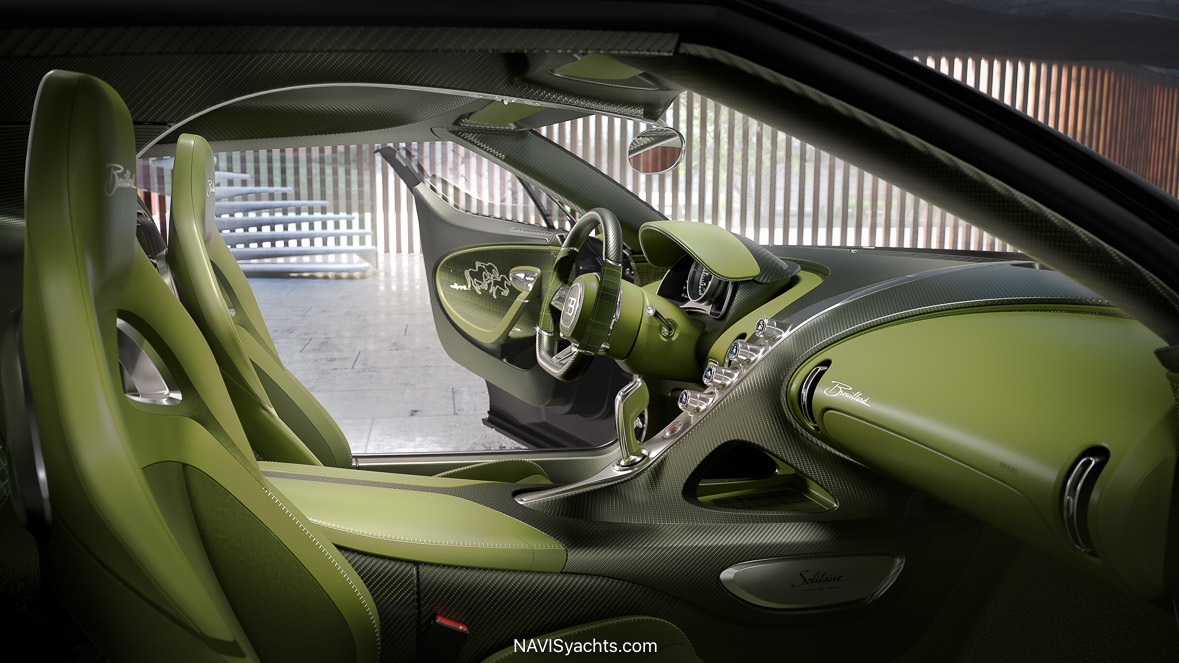
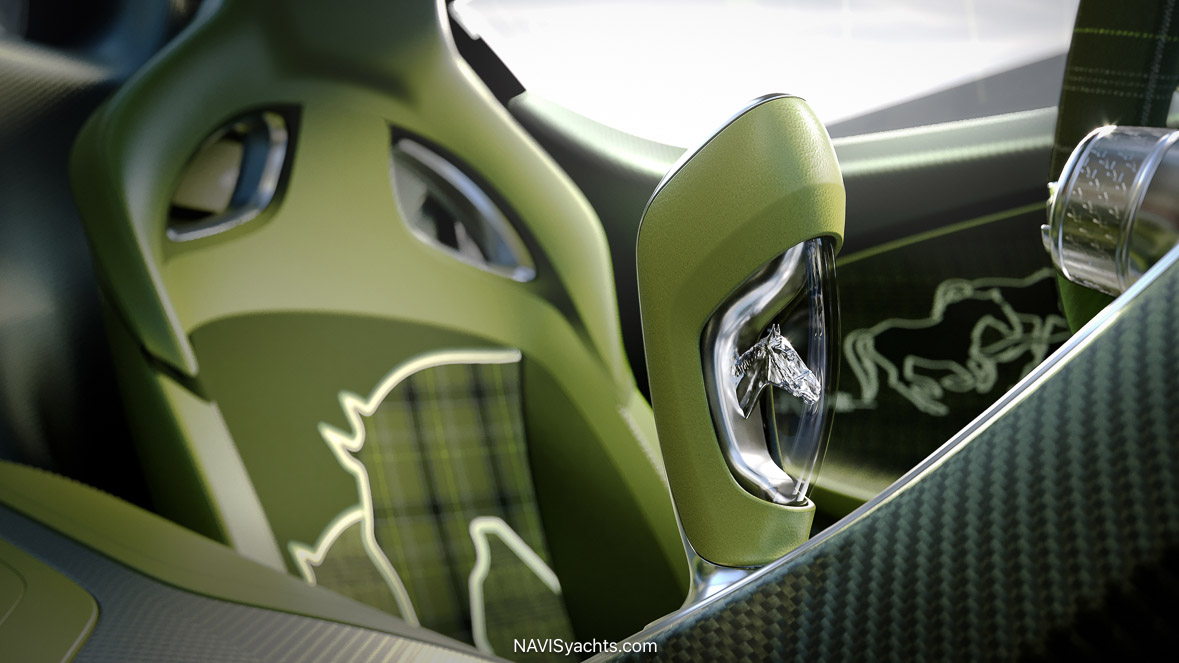
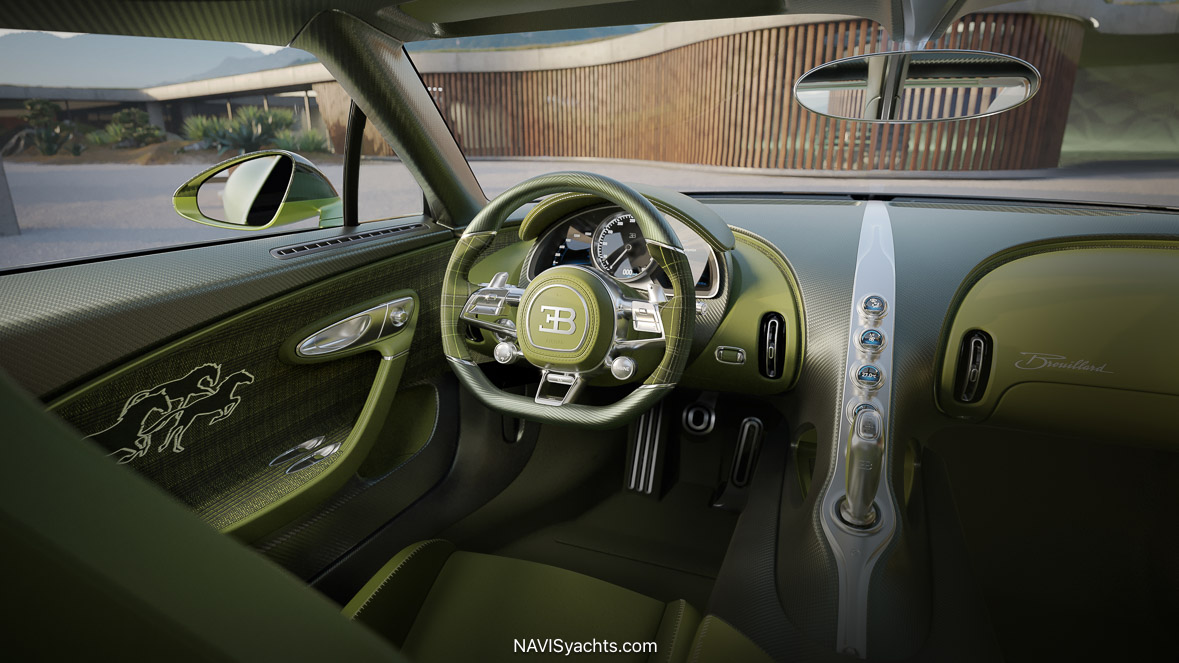
It’s still sculptural in here, still quiet in its confidence, but the palette shifts. Tartan fabrics stitched into the seats, green-tinted carbon weave across the door sills and center console, machined aluminum punctuating every control. At first glance, the gear shifter appears to be a single aluminum piece, like a watch crown scaled up. But inside it, suspended in a glass insert, is a miniature sculpture of Brouillard, Ettore’s favorite horse, the one who inspired this entire car. It’s absurd. It’s beautiful. It’s the kind of detail you don’t notice until your second or third sit. And then you can’t unsee it.
The glass roof floods the cabin with natural light, filtering down onto the continuous center spine, a design element that runs from the nose of the car, through the cockpit, and fades into the tail. It gives the whole cabin a sense of architecture, like being inside a structural beam that happens to have tartan seats and 1,600 PS.
About that power, yes, it’s still the W16. The final form. Quad-turbocharged, 8.0 liters, delivering numbers that make hypercar checklists blush. But in Brouillard, it’s not performative. There’s no need to rev for drama or chase induction noises. Start it, and it settles into a hum, refined and composed, like it’s waiting for the conversation to come to it.
Everything about how Brouillard moves is measured. Deliberate. The massive power doesn’t scream for your attention. It’s just there, waiting behind a glass wall of refinement. When you finally lean into it, you feel the full force of nearly two decades of Bugatti engineering, but you also feel how hard they’ve worked to make it civilized.
Even the aero is refined. The fixed ducktail isn’t a flex. It’s a necessity, packaged so cleanly into the bodywork that it feels like sculpture. The rear diffuser, the sculpted side intakes, the invisible airflow management, none of it distracts. All of it works. You’re not reminded that the car is managing heat, downforce, and stability. You’re just reminded how smooth everything feels at pace.
A Bugatti’s Axis Shift
You can trace Bugatti’s modern history in phases, Veyron as proof of concept, Chiron as confidence, Divo and La Voiture Noire as performance couture. But Brouillard feels like the brand turning inward. It’s about deepening meaning.
The Programme Solitaire is something entirely new. Not just a series of bespoke commissions, but a platform for philosophical clarity, where heritage isn’t mined for marketing, but interpreted through design. It’s coachbuilding in the truest sense: an object built around a story, for a singular person, with full factory resources behind it.
Two builds a year, no more. Each one a direct conversation between the client and Molsheim’s top minds in materials, aero, and aesthetics.
In this case, that conversation began with horses and spiraled into a car that feels like an abstract portrait of Ettore Bugatti’s affections. Brouillard isn’t nostalgic. It isn’t trying to be a modern Atlantic or a reborn Type 57. It is, in its own quiet way, a reset. The W16 will not return in future cars. Nor will this exact chassis. Which makes this the last expression of an era before Bugatti steps into electrification, hybridization, and whatever follows.
For the commissioning owner, a collector already deep into Bugatti lore, this car is both curation and contribution. A celebration of the Bugatti family’s far-reaching creative legacy. It’s automotive as gallery, but it still starts, still drives, still moves with the same authority as any modern Bugatti. The difference is where it’s going.
And where Bugatti is going, Solitaire might be the blueprint. A program that allows the brand to craft cultural objects. To build cars with as much emotional depth as they perform. Brouillard is the first. It won’t be the fastest Bugatti, or the rarest in the strictest sense. But it may be the one that best understands what Ettore Bugatti was really chasing all along: something elegant enough to be admired and complex enough to be remembered.

Photos: Bugatti Media | Words: Pablo Ferrero