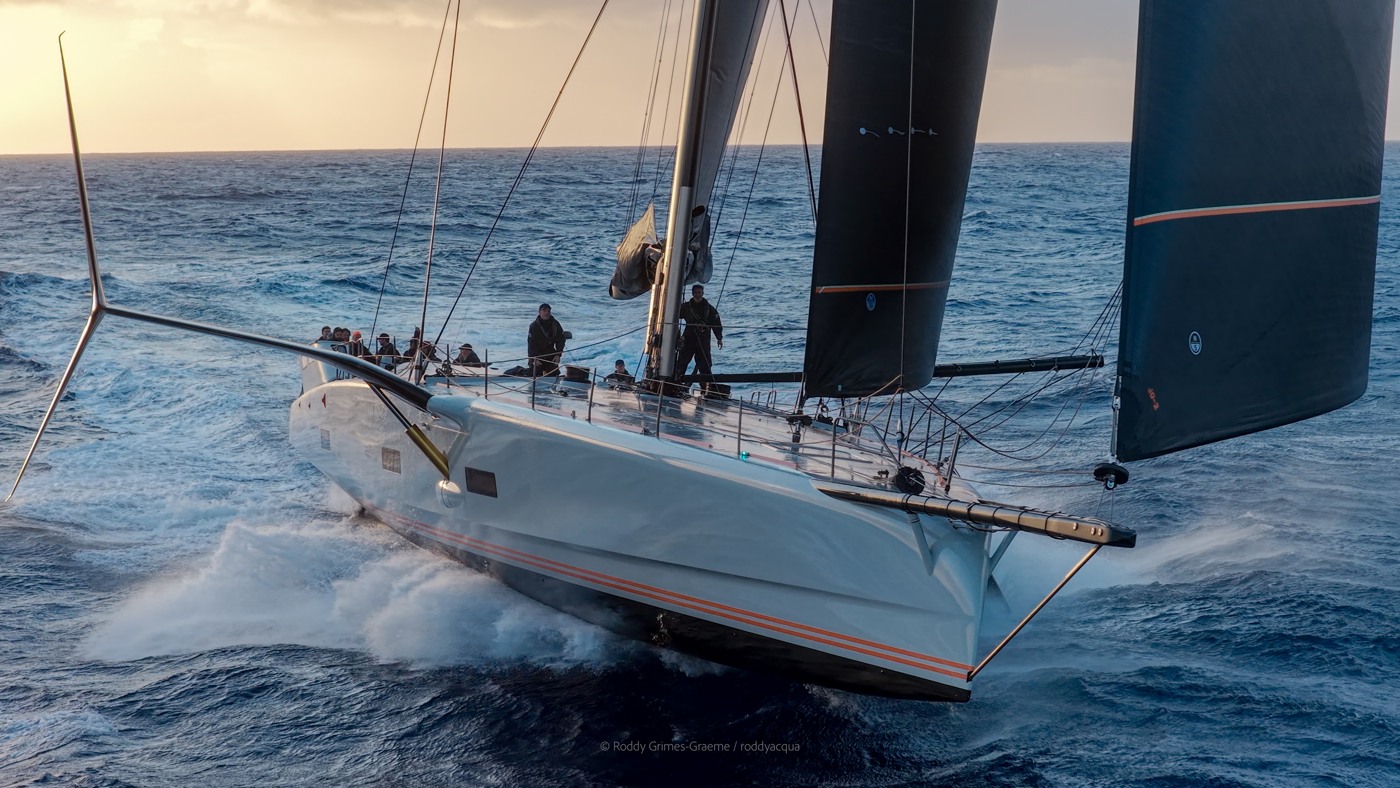
ENGLISH HARBOUR, ANTIGUA — In the dark, early hours off the coast of Antigua, the future of offshore racing arrived at thirty knots. The 34-metre Baltic 111 Raven did not just win the 2026 RORC Transatlantic Race; she dismantled the established order. Crossing the finish line on January 18 to claim Monohull Line Honours and the IMA Transatlantic Trophy, Raven stopped the clock with a time of six days and 22 hours, shattering the monohull race record and completing the 3,000-nautical-mile sprint from Lanzarote in under a week.
For the yachting industry, this is more than a trophy win; it is a validation of one of the most audacious naval architecture experiments of the last decade. Raven is a vessel that defies traditional categorization—neither a displacement yacht nor a fully flying foiler, but a foil-assisted ultra-lightweight hybrid designed to sit in the sweet spot of high-speed stability.
"It was truly fantastic to see Raven perform so well in her first outing. The boat did exactly what she was designed to do, and watching her sail with such confidence and speed was incredibly rewarding for the whole team." — Mattias Svenlin, Project Co-ordinator at Baltic Yachts.
(Visual Content Suggestion: Include a high-contrast, high-resolution image of Raven crossing the finish line at night, highlighting the spray and the sheer power of the vessel.)
Engineering the "Unthinkable" Speed
The secret to Raven’s record-breaking pace lies in her ability to sustain high average speeds without the volatility associated with fully flying foilers. While America’s Cup boats fly entirely out of the water, Raven uses her foils to generate massive righting moment and lift, reducing displacement while keeping the hull largely in contact with the sea.
Project Manager Claes Nyloef believes this configuration represents the practical future of ocean racing. "This is a way forward," Nyloef asserted after the race. "You get foiling performance without fully flying, which is critical for ocean racing. It’s a very good combination of a fast monohull and foiling technology. I think you will see more boats like this."
The sensation onboard is unlike anything previously experienced on a monohull of this scale. Nyloef describes the acceleration as "breathtaking," a feeling previously reserved for multihulls. "When she starts accelerating, it doesn’t stop," he noted.
Raven vs. The Titan: Comparing Comanche
To understand the magnitude of Raven’s achievement, one must compare her to the previous benchmark: the 100-foot maxi Comanche. Will Oxley, the seasoned navigator who guided Comanche to the race record in 2022, was aboard Raven for this historic crossing. His comparison offers a fascinating glimpse into the evolution of maxi design.
"It’s fascinating to compare Raven and Comanche," Oxley explained. "Comanche is still the global benchmark in VMG (Velocity Made Good) downwind sailing, but Raven has clear performance advantages at certain angles."
Oxley noted that while Comanche relies on sheer power and form stability for deep downwind VMG, Raven excels at reaching angles where her foils can be fully utilized. "In this race, which is largely a classic downwind Atlantic crossing, when we’re sailing our angles we’re faster... Raven is an incredible platform, and what we’ve achieved here sets a very serious benchmark."
Safety Through Speed
One of the most counterintuitive aspects of the Raven project is the relationship between velocity and safety. Skipper Damien Durchon emphasizes that the yacht actually becomes safer the faster she goes, a paradox created by her active foil system.
"This boat is incredibly stable," said Durchon. "The better it performs, the safer it becomes. We have huge righting moment from the foils, backed up by 10 tonnes of water ballast and strong hull form stability."
Unlike fully foiling yachts that can crash down violently if they ventilate or stall a foil, Raven’s hybrid mode offers a fail-safe. "If a foil stalls, the boat simply behaves like a conventional yacht. In many respects, I would say Raven is safer than most offshore boats," Durchon added. This stability allowed the crew to push the boat through the Atlantic swell at speeds exceeding 30 knots, where the yacht was effectively moving faster than the wave trains themselves.
(Visual Content Suggestion: Suggested infographic: A technical comparison of Raven’s foil-assisted hull versus a traditional canting-keel maxi, illustrating the difference in wetted surface area.)
The Human Element: A "No Friction" Crew
Technological marvels are useless without a team to tame them. Sailing Master Brad Jackson was quick to point out that the record was the result of a disciplined, professional approach rather than a reckless sprint.
"If you complete a race like this in under seven days, a lot has gone right," Jackson said. "This wasn’t a sprint with everything on the edge, it was about keeping the boat in one piece and letting it do what it’s designed to do."
The crew dynamic was described as "positive" and "professional," with Jackson and Oxley cultivating an atmosphere where humour remained intact despite the fatigue of a sub-seven-day crossing. "There’s no friction," Oxley remarked. "People want to sail this boat because of the platform, but also because of the team."
A Dramatic Finish
The race concluded with a high-stakes approach into Antigua. On a pitch-black night with no moon and shifting pressure, the navigation team had to execute a precise layline to maintain momentum into the finish.
"We wanted to call a good layline for the finish," Oxley recalled. "With a bit of practice and a bit of luck, we nailed it and crossed the finish doing over 30 knots. That was a pretty special way to end the race."
Greeted by The Hon. Charles ‘Max’ Fernandez, Antigua’s Minister of Tourism, the team celebrated not just a win, but a statement. Raven has established herself as the boat to beat, likely securing the overall IRC corrected-time lead in addition to her line honours victory.
The Future of the Monohull
As Raven rests in English Harbour, the implications of her performance are already rippling through the superyacht industry. She has proven that foil-assisted monohulls can survive—and thrive—in the harshest ocean conditions, bridging the gap between comfort, safety, and raw, adrenaline-inducing speed.
"To set a record in your first attempt is something very special," concluded Skipper Durchon.
Stay tuned to NAVIS for exclusive interviews with the design team and a full technical breakdown of Raven's foil systems.