The launch of the custom 95-foot sailing yacht Ouzel in Maine marks a significant milestone for U.S. superyacht construction, blending traditional cold-molded techniques with high-performance carbon engineering.
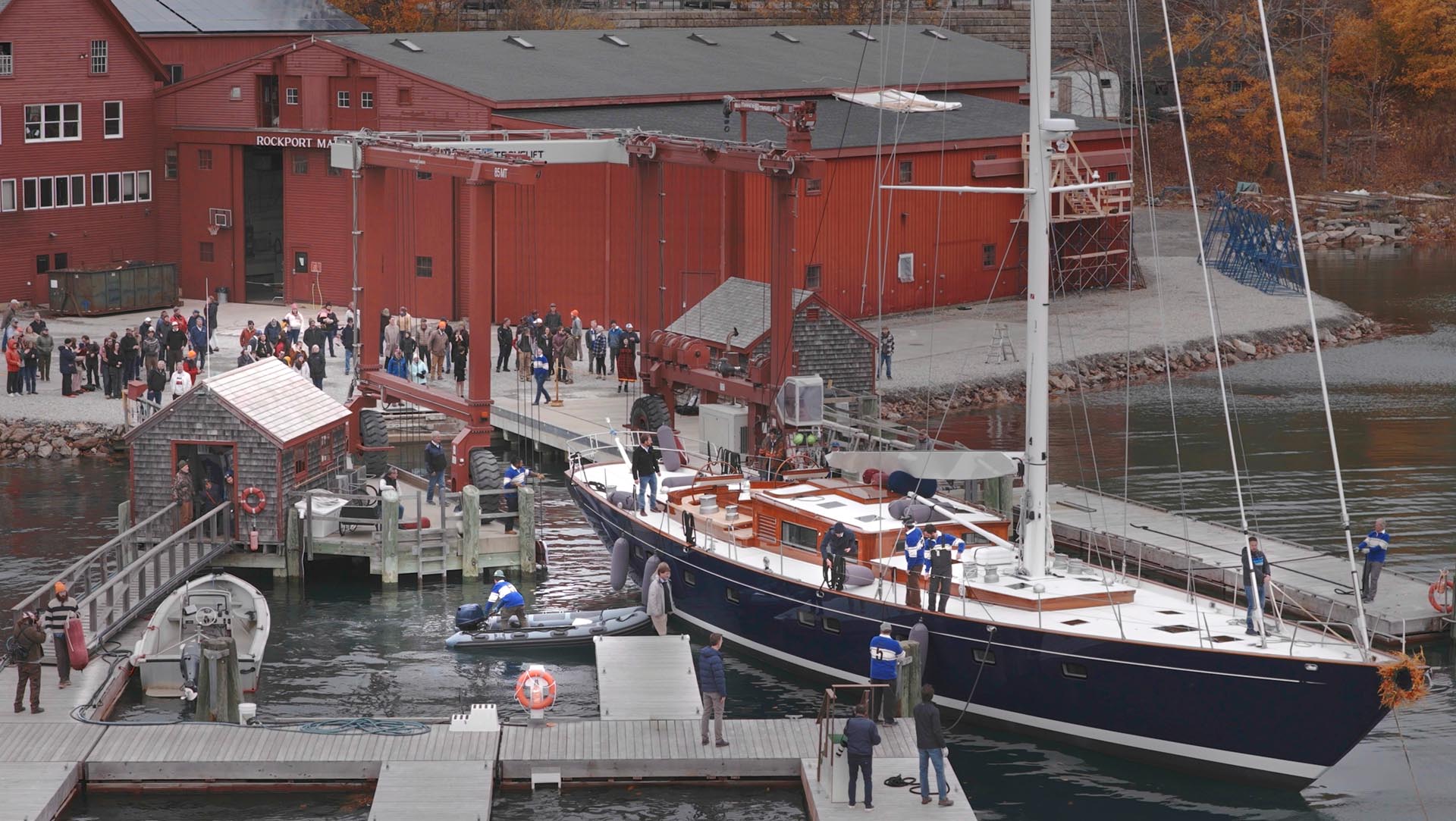
November 2025 (Rockport, Maine) – The icy waters of Rockport Harbor witnessed a significant moment for the American superyacht industry this week. Rockport Marine successfully completed the technical launch of Ouzel, a 95-foot (29-meter) custom sloop that challenges the prevailing dominance of European shipyards in the sailing superyacht sector. Following her float-out, the vessel has immediately commenced mechanical and systems trials.
This launch represents the culmination of a three-year collaboration between a global team of designers and builders. The project brings together the expertise of Newport-based Langan Design Partners, UK-based Mark Whiteley Design, and the seasoned project management team at MCM Newport. For the owner, an experienced yachtsman, the decision to build in Maine was a deliberate choice to leverage New England’s deep maritime heritage rather than defaulting to established European yards.
Reviving the New England Superyacht Tradition
The launch of Ouzel is more than just the delivery of a new vessel; it signals a potential resurgence in high-end American custom yacht building. For decades, the perception has persisted that complex superyacht projects of this caliber were the exclusive domain of Dutch, Finnish, or Italian yards. Ouzel directly confronts this narrative.
Peter Wilson, President of MCM Newport, emphasized the caliber of the work coming out of Maine. He noted that while many believe such yachts cannot be built in the United States anymore, the Ouzel team has proven otherwise. Wilson stated that the yacht stands shoulder to shoulder with the finest European builds, potentially even surpassing them in specific areas of craftsmanship.
This project highlights a return to the tradition of New England builders executing large-scale, world-class yachts through regional and global collaboration.
Engineering the "Wood-Composite" Advantage
While Ouzel presents the aesthetic of a modern classic, her construction relies on a highly advanced hybrid technique. Rockport Marine utilized a wood-composite construction method that offers distinct advantages over pure carbon fiber or aluminum builds.
This technique involves an engineered blend of materials:
-
Cold-molded wood: Serving as the primary structural core.
-
Carbon fiber and E-glass: Providing high-tensile reinforcement.
-
Foam coring: Used strategically to reduce weight without sacrificing stiffness.
Sam Temple, President of Rockport Marine, noted that this method is gaining acceptance for good reason. It delivers the low-maintenance benefits of a composite vessel while retaining the technical and aesthetic advantages of wood.
Mark Whiteley of Mark Whiteley Design added that this build technique enhances the interior ambiance significantly. Beyond the structural integrity, the wood-composite hull improves the acoustic qualities of the yacht, dampening vibration and sound more effectively than metal or solid laminate. It also contributes a subtle, natural aromatic quality to the interior spaces that synthetic materials cannot replicate.
A Synthesis of Performance and Style
The design brief for Ouzel called for a "modern classic" – a vessel capable of long-range world cruising with high levels of comfort, yet performing beautifully under sail.
Langan Design Partners (Newport, R.I.) led the naval architecture, ensuring the 95-footer possesses the seakeeping abilities required for global voyages. Their work was complemented by Mark Whiteley Design (Lymington, U.K.), who handled the interior design and assisted with exterior styling. The result is a yacht with a sleek, contemporary profile that honors classic proportions.
Tom Degremont of Langan Design Partners praised the shipyard's ability to merge these dual requirements. He observed that the Rockport team successfully blended ageless boatbuilding skills with modern techniques to create a yacht that is both strong and graceful.
Global Collaboration and Execution
The successful delivery of a custom superyacht often hinges on communication, particularly when the team is dispersed across the Atlantic. The build process for Ouzel utilized a rigorous schedule of weekly video calls involving the design partners, the builder, and the project management team at MCM.
Beyond digital collaboration, the teams met periodically in Rockport to review full-scale mock-ups. These physical reviews allowed the owner and designers to assess progress in real-time and refine details before final installation, smoothing the complex process of custom construction.
Next Steps: Sea Trials and Delivery
With the technical launch complete, Ouzel now transitions from a construction project to an operational sailing vessel. The immediate focus shifts to mechanical and systems trials in the waters off Maine. These tests will validate the engineering calculations and ensure all onboard systems meet the owner's requirements for comfortable long-range cruising.
Peter Wilson remarked that the team is now enjoying the phase where the yacht becomes fully operable, noting that the results have fully justified the owner's decision to build in the U.S..
As Ouzel prepares for her maiden voyage, she stands as a powerful example of American craftsmanship in the 21st century.
Stay tuned to NAVIS for exclusive performance results from Ouzel's upcoming sea trials.