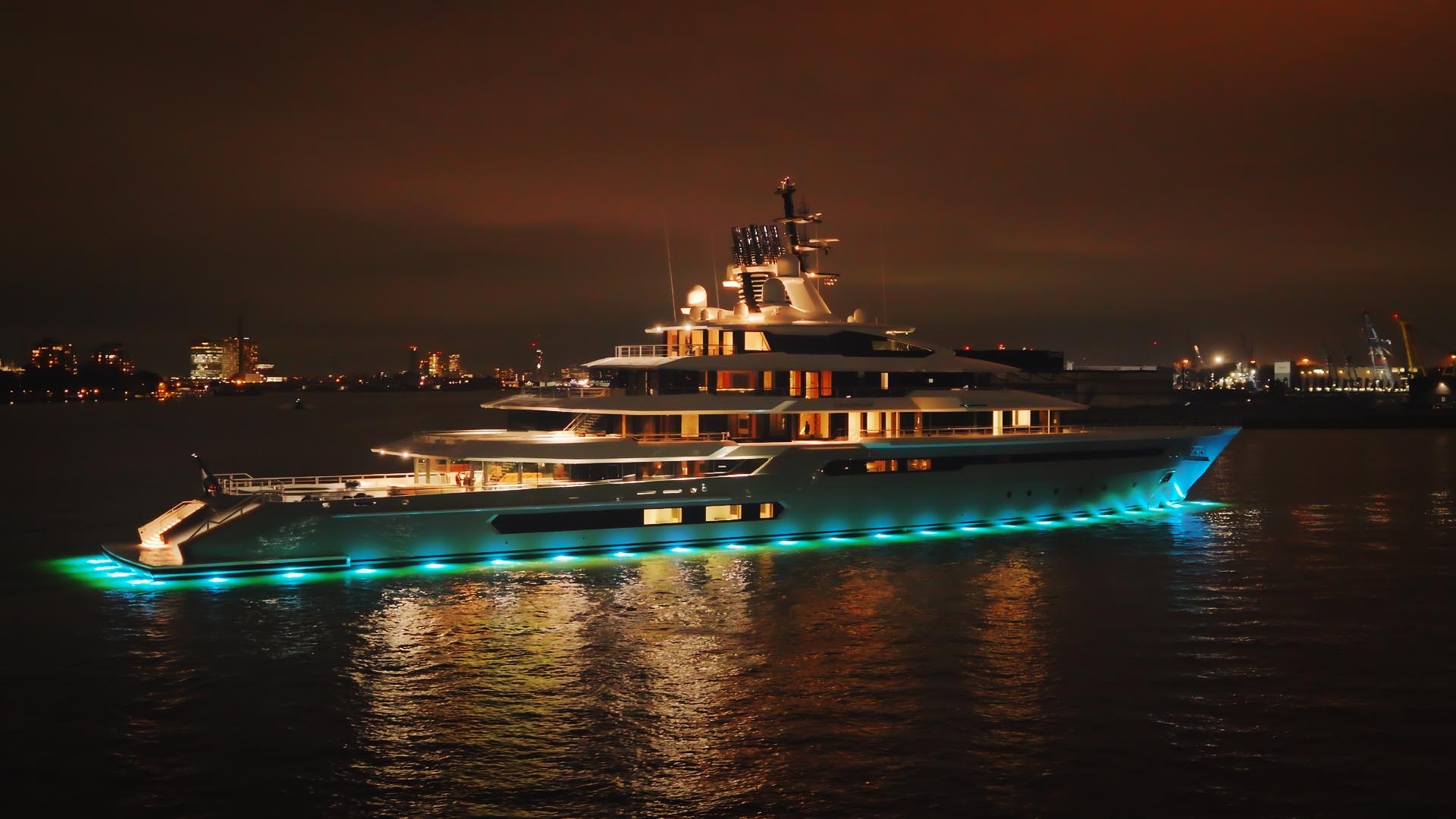
The landscape of the superyacht industry often focuses on length, volume, and opulent finishes. However, the delivery of the 111-meter (363ft) Leviathan by Dutch builder Oceanco marks a distinct pivot toward a different metric: utility and community. Formerly known as Project Y722, this diesel-electric vessel is not merely a private residence at sea. It represents a fundamental rethinking of the operational hierarchy onboard, driven by the vision of her owner, Gabe Newell.
Newell, known for his influential role in the technology and gaming sectors, approached the build with an ethos grounded in teamwork. The result is a vessel where the lines between guest luxury and crew operation are intentionally blurred to foster a cohesive onboard culture. Following successful sea trials and her recent delivery, Leviathan stands as a highly technical platform designed for global exploration, scientific research, and community building.
A Collaborative Philosophy
The development of Leviathan was characterized by an unusual level of integration between the client and the build team. The project saw close cooperation between Oceanco, the owner’s representatives at YTMC and Y.CO, and the design studio Mark Berryman Design. Unlike traditional builds where the owner’s team and the shipyard might remain in separate silos, Newell encouraged openness throughout the process.
Marcel Onkenhout, CEO of Oceanco, noted that the project deviated from traditional methods from the very start. The shipyard team was welcomed alongside the owner and the future crew, creating a unified group focused on a singular goal. This collaborative spirit is permanently recorded in the vessel’s architecture. A glass panel installed in the main staircase features the engraved names of nearly 3,000 contributors who worked on the yacht. This installation serves as a permanent record of the human effort required to bring such a complex machine to life.
Patrick Casanova of the Oceanco Design team described the journey as an unforgettable human adventure. The process evolved from a simple sketch into a complex reality, leaving the team with a profound sense of humility regarding the scale of their accomplishment.
Reimagining the Interior Layout
The most significant deviation from standard yacht design lies in the interior arrangement. Accommodating up to 26 guests and 37 crew, the layout prioritizes shared experiences. In a move that challenges industry norms, prime real estate typically reserved exclusively for the owner or VIP guests has been allocated to communal use.
Interior designer Mark Berryman, who has nearly three decades of experience, described the project as a challenge to convention. This represents a new operational perspective. The bridge deck, for instance, houses a massive communal gaming lounge. This space replaces the traditional aft saloon and is equipped with 15 gaming stations, two racing simulators, and extensive lounge seating.
Furthermore, the main deck saloon has been transformed into a "mess hall" concept capable of dining up to 54 people simultaneously. This allows crew and guests to interact freely, reinforcing the owner’s belief that a yacht should function as a community. Crew well-being is further supported by high-end accommodation finishes utilizing oak and deep wenge, along with access to leisure areas such as a basketball court and a sundeck whirlpool.
Crew-Centric Ergonomics
The focus on people extends deeply into the operational aspects of the vessel. The design team operated under the logic that freeing the crew from repetitive, low-value maintenance tasks would allow them to focus on professional development and guest interaction.
Material choices were heavily influenced by this pragmatic approach. The exterior decking utilizes a fully synthetic solution from Bolidt. This material is durable and requires significantly less maintenance than traditional teak. Additionally, a custom compound was developed specifically for Leviathan through a collaboration between the crew, Oceanco, and Bolidt to improve heat dissipation.
Further reducing maintenance hours, the exterior railings feature bead-blasted stainless steel and synthetic handrails. This choice eliminates the need for constant polishing. Even the off-white paint utilized on the hull was selected to minimize the visibility of salt and dirt, reducing the frequency of wash-downs.
Gilles Vernhet of the Oceanco Design team noted that the exterior blends functionality with a striking forward-leaning silhouette. The use of prismatic forms and specific materials creates a fluid design that remains practical for daily operations.
Engineering for Silence and Comfort
Beneath the waterline, Leviathan utilizes a highly advanced technical platform. The hull form is an evolution of Lateral Naval Architecture’s DE-Series. This design is engineered specifically for large yachts operating at moderate speeds with podded propulsion.
Extensive testing at MARIN (Maritime Research Institute Netherlands) was conducted to optimize the hull for seakeeping. The vessel features a natural roll period exceeding 12 seconds. Stability is further managed by a system combining Quantum MagLift and XT Fins, ensuring a stable platform both at anchor and underway.
Propulsion is provided by a diesel-electric architecture driving two ABB DO980P Azipods. This system allows for flexibility in the general arrangement. Because the engine room does not require a direct shaft line to the propellers, it was positioned further forward than usual. This placement freed up valuable volume in the aft section of the yacht, traditionally the most stable area, for guest accommodation.
The technical team went to great lengths to reduce noise and vibration. Captain Alan Pike highlighted the extraordinary silence of the vessel, even at full speed. To achieve this, the Azipod foundations were stiffened to minimize hull vibrations, and the propellers were tuned via cavitation testing to reduce pressure pulses.
Advanced Systems and Sustainability
Leviathan incorporates a 5.5 MWh battery bank. This energy storage system allows for silent operation at night and provides peak shaving to optimize engine efficiency. By running engines at their optimal load, the system improves fuel efficiency and extends maintenance intervals.
Air quality was another priority for the owner's technical team. A custom air filtration and monitoring system from VFA Solutions was integrated into the vessel. This system cleans and purifies onboard air, a feature rarely seen at this scale and complexity.
To address internal noise, the builders constructed full-scale mock-ups of HVAC components to measure sound transmission through ducting. These results informed the acoustic models applied across the yacht. Similar attention was paid to the windows, where lab testing analyzed how external vibrations translated into internal noise, leading to optimized integration methods.
A Platform for Scientific Impact
Leviathan is not merely a leisure vessel. She is a working asset within the Inkfish fleet. Inkfish is an organization supported by Newell that focuses on marine exploration and scientific research. The yacht is equipped to support these missions with facilities that rival dedicated research vessels.
The layout includes a fully equipped dive center, a laboratory, and an onboard hospital. These facilities occupy the stern area usually designated for a beach club. Additionally, a dedicated 3D printing workshop allows the crew to manufacture spare parts while at sea, enhancing the vessel’s self-sufficiency in remote regions.
The yacht joins the research vessel R/V Dagon, which operates a full-ocean-depth submersible. Leviathan serves as a mothership and a hub for researchers, providing access to cutting-edge technology and comfortable quarters during expeditions.
The delivery of Leviathan signifies a maturing of the superyacht industry. It moves the conversation away from pure aesthetics and toward operational purpose. By prioritizing the well-being of the crew, integrating advanced propulsion technology, and dedicating substantial volume to scientific research, Oceanco and Gabe Newell have created a vessel that functions as a cohesive ecosystem.
As Leviathan begins her global itinerary, she offers a case study in how owner vision can drive technical and functional innovation.
Main Characteristics
| Feature | Specification |
| Length Overall | 111m / 364ft |
| Beam Overall | 17.8m / 58ft |
| Gross Tonnage | 4,970 GT |
| Builder | Oceanco |
| Exterior Design | Oceanco |
| Interior Design | Mark Berryman Design |
| Naval Architecture | Oceanco & Lateral |
| Propulsion | Diesel-Electric / Azipods |
| Top Speed | 17.6 knots |
| Cruising Speed | 13 knots |
| Guests / Crew | 26 / 37 |
Stay tuned to NAVIS for further updates on the technical performance of the DE-Series hull as Leviathan undertakes her first major voyages.