
Racing History Meets Haute Horlogerie
A racing car’s braking system is an unlikely starting point for a luxury watch. Yet for independent Franco-Swiss watchmaker Lorige, it has become the foundation of a distinctive identity. The company transforms Carbon/Carbon brake components recovered from endurance racing into the cases of mechanical timepieces, preserving the physical history of competition within objects intended to last for generations. Unveiled at TimeToWatches 2026 in Geneva, the Bleu Asphalte Gold Edition introduces a new dimension to this concept, combining race-used carbon composite with 18-karat 5N rose gold and the mechanical sophistication of a manually wound movement offering seven days of autonomy.
Founded in 2018 by Clément Etienvre and Emeric Paraud, Lorige grew from their experience in automotive engineering, composite materials, and endurance racing. Both understood the remarkable capabilities of the components used in competition, but they also recognized the possibility of preserving their history. After three years of development, the company established a patented process for converting used racing brake material into precision-machined watch cases. The result was an approach to watchmaking in which the provenance of the material became as important as the mechanical construction and design surrounding it.
From the Racetrack to the Wrist
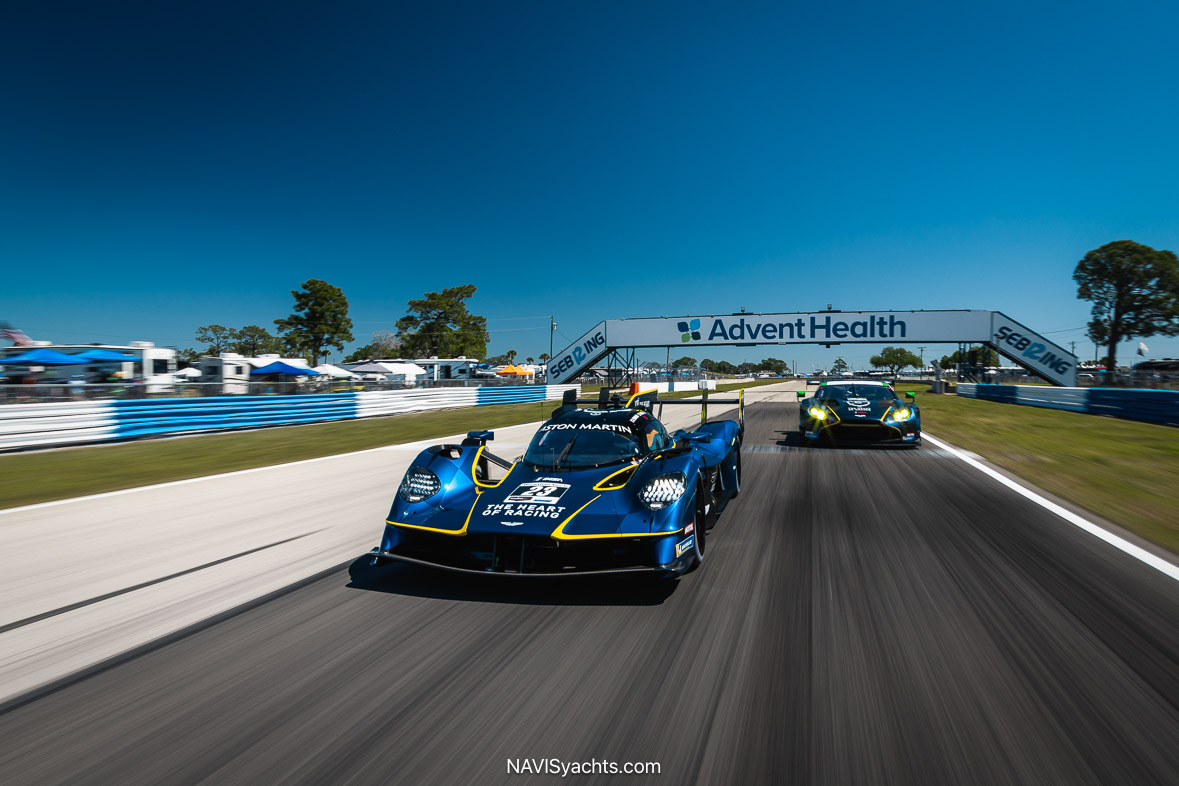
The Bleu Asphalte Gold Edition has a particularly compelling origin. Its Carbon/Carbon case comes from brake components used by the Heart of Racing Valkyrie No. 23 during its podium-finishing performance at the 2025 Petit Le Mans. Before becoming part of a mechanical watch, this material had already experienced the considerable thermal and mechanical stresses of endurance racing. Its history is embedded in the structure of the case rather than represented through decorative references.
Originally developed for aerospace applications, Carbon/Carbon is a composite in which carbon fibers are embedded within a carbon matrix. Unlike conventional carbon-fiber composites that rely on polymer resins, this construction tolerates the exceptionally high temperatures encountered in racing brake systems. Under competition conditions, such components can experience temperatures approaching 900°C while absorbing and dissipating enormous amounts of kinetic energy. Their effectiveness depends on maintaining structural integrity through repeated braking cycles, making the material particularly valuable in applications where heat and mechanical stress are inseparable.
Turning these components into a watch case requires an entirely different manufacturing discipline. Lorige’s proprietary process involves alternating thermal treatments and vacuum cycles to densify the material, followed by seven precision-shaping stages. According to the manufacturer, producing a single case requires more than 30 hours of manufacturing. The challenge lies in achieving the dimensional accuracy demanded by watchmaking while preserving the composite’s distinctive structure. Its irregular patterns emerge naturally during processing, giving every finished case a slightly different appearance. No two examples are visually identical.
The Architecture of Contrast
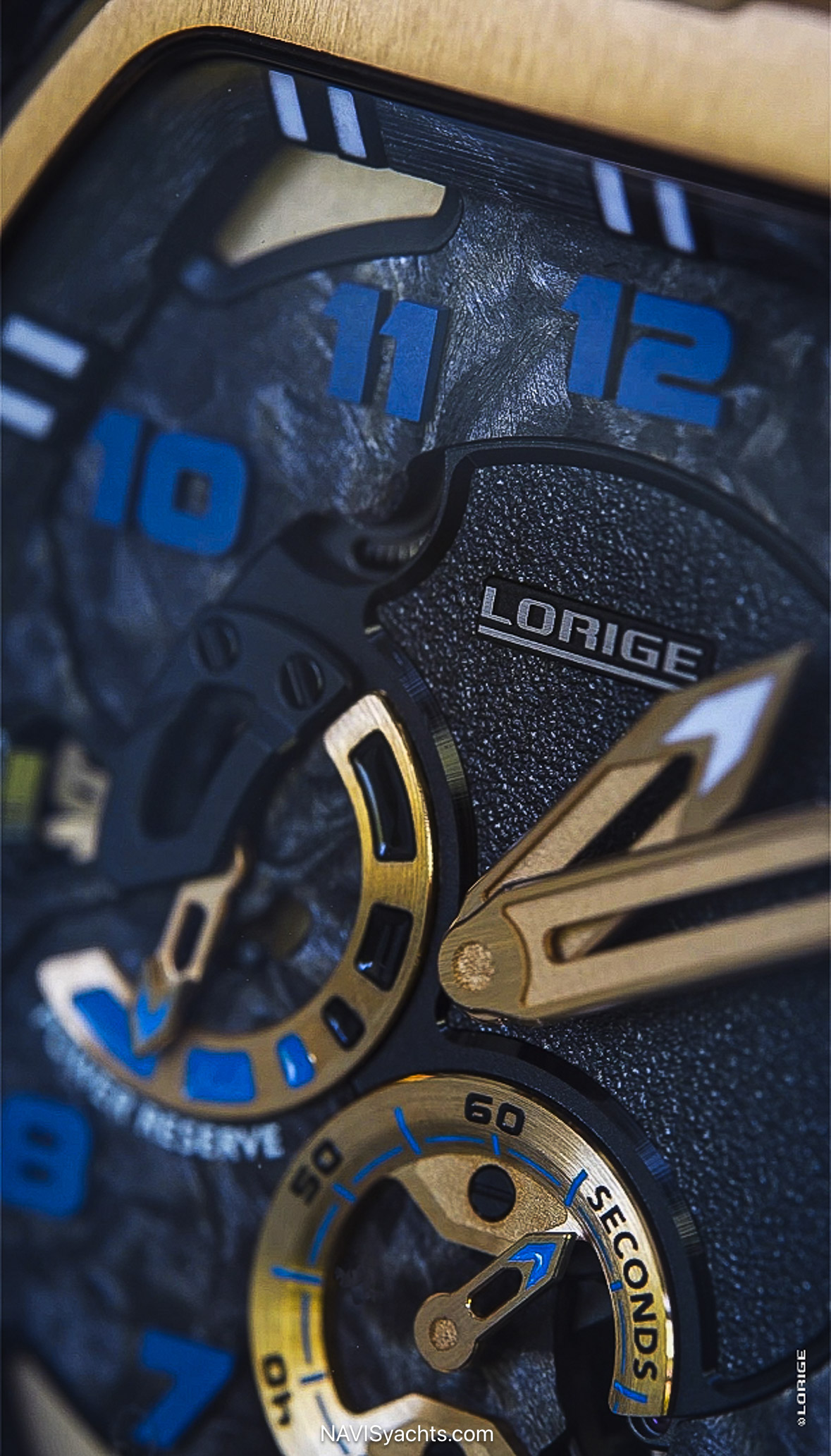
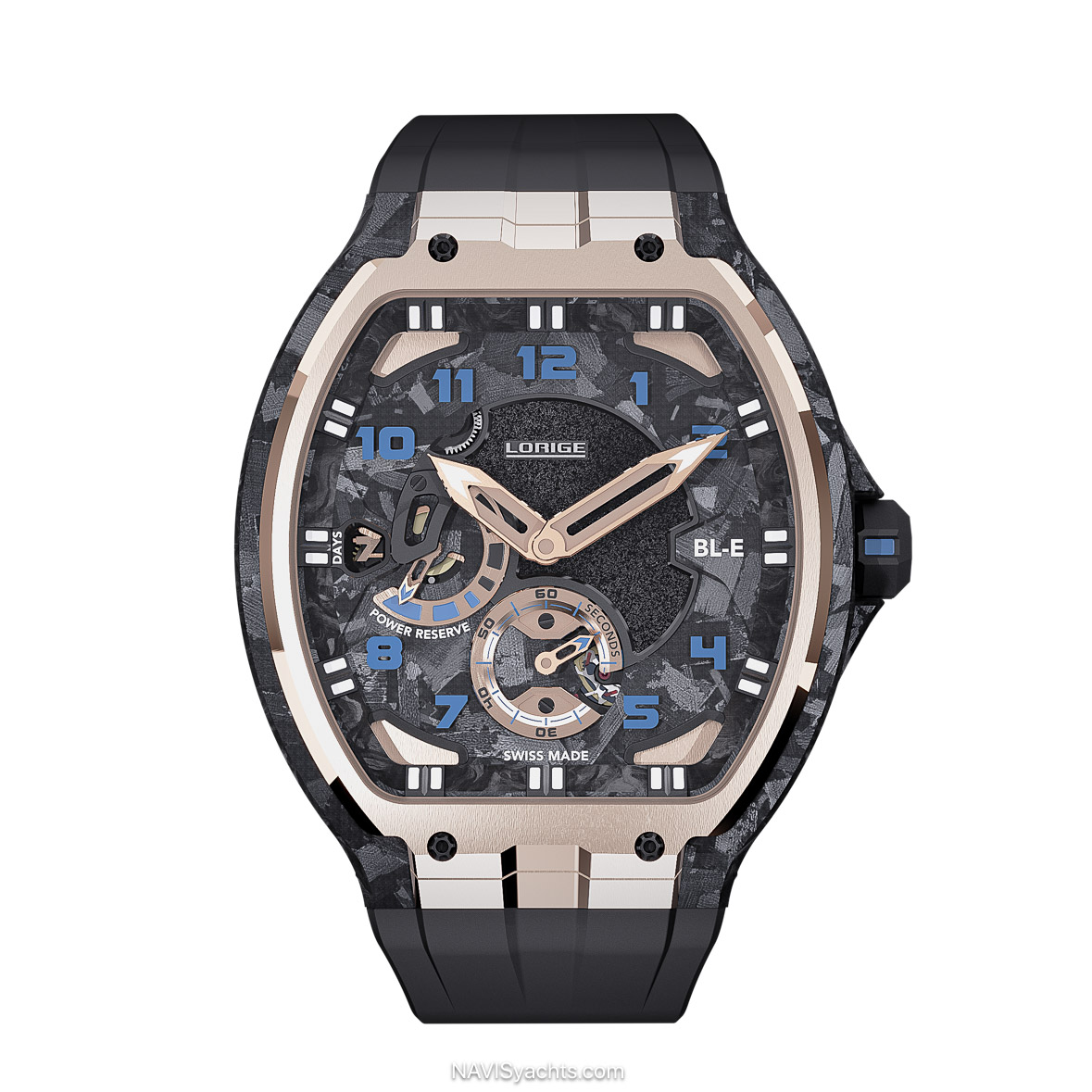
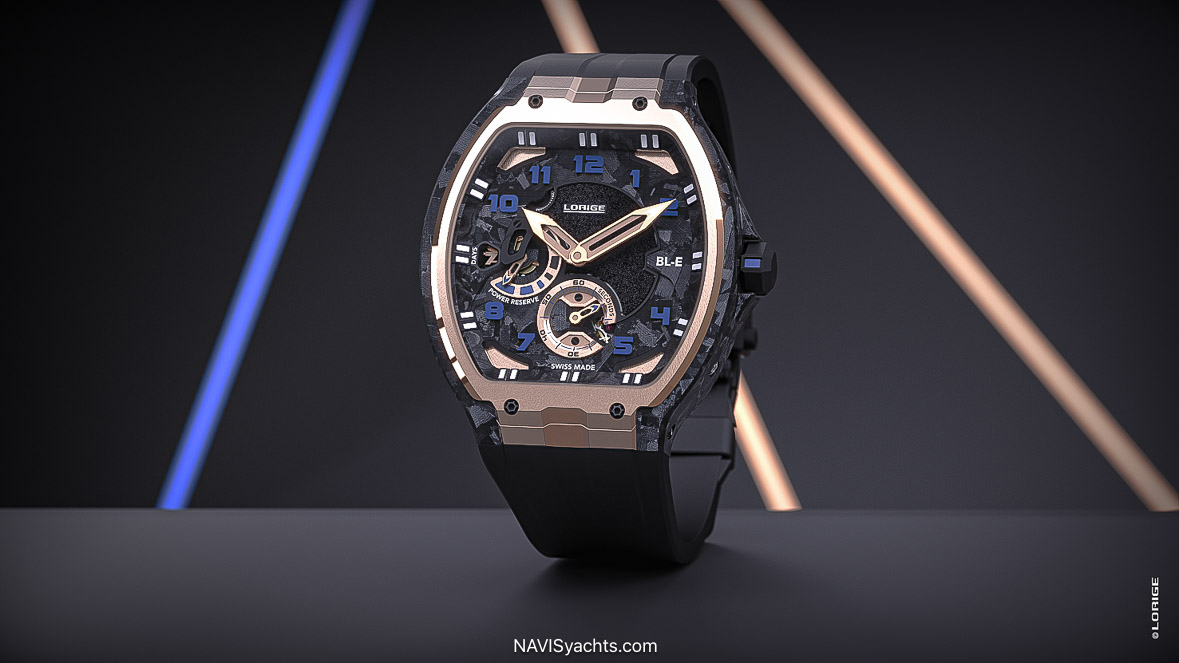
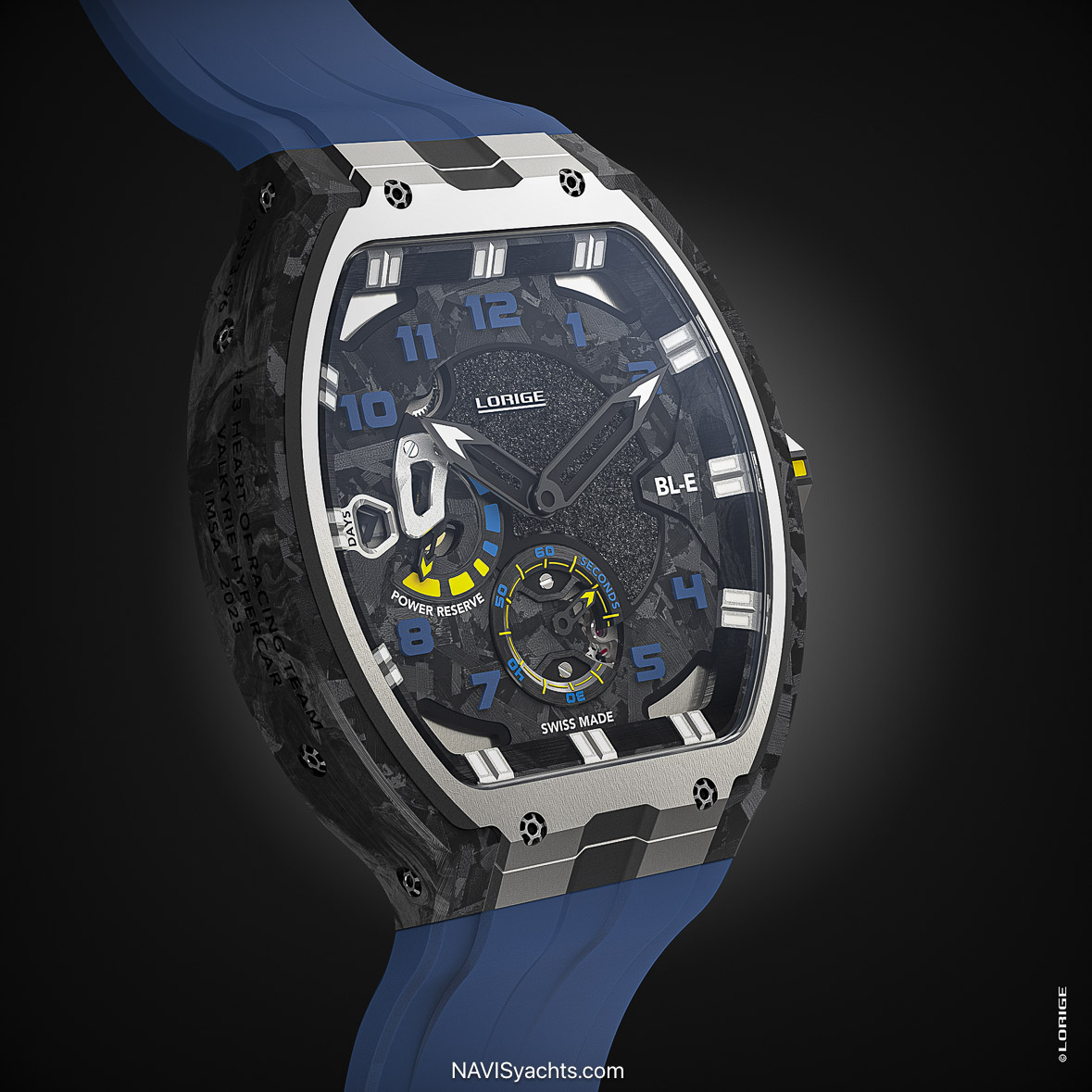
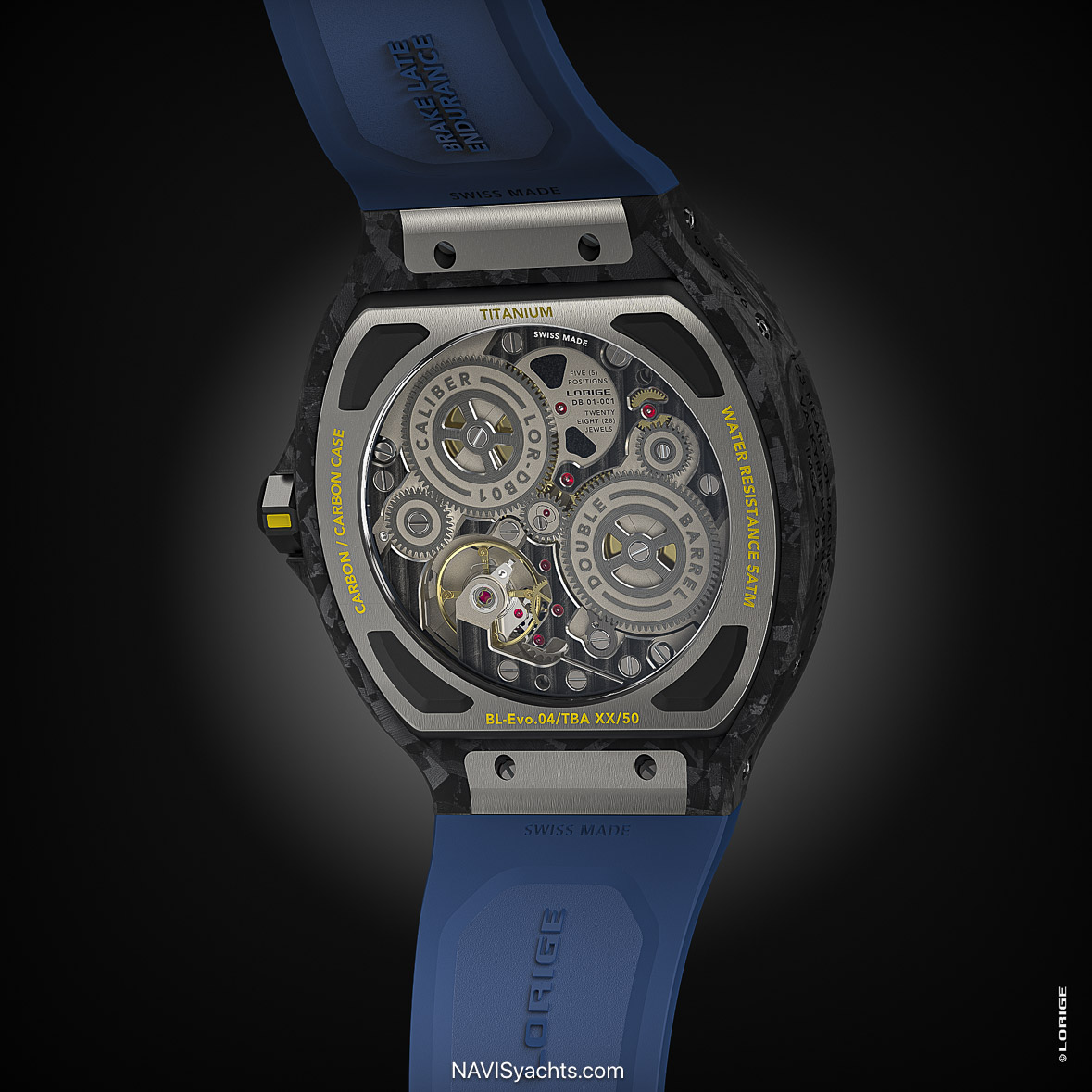
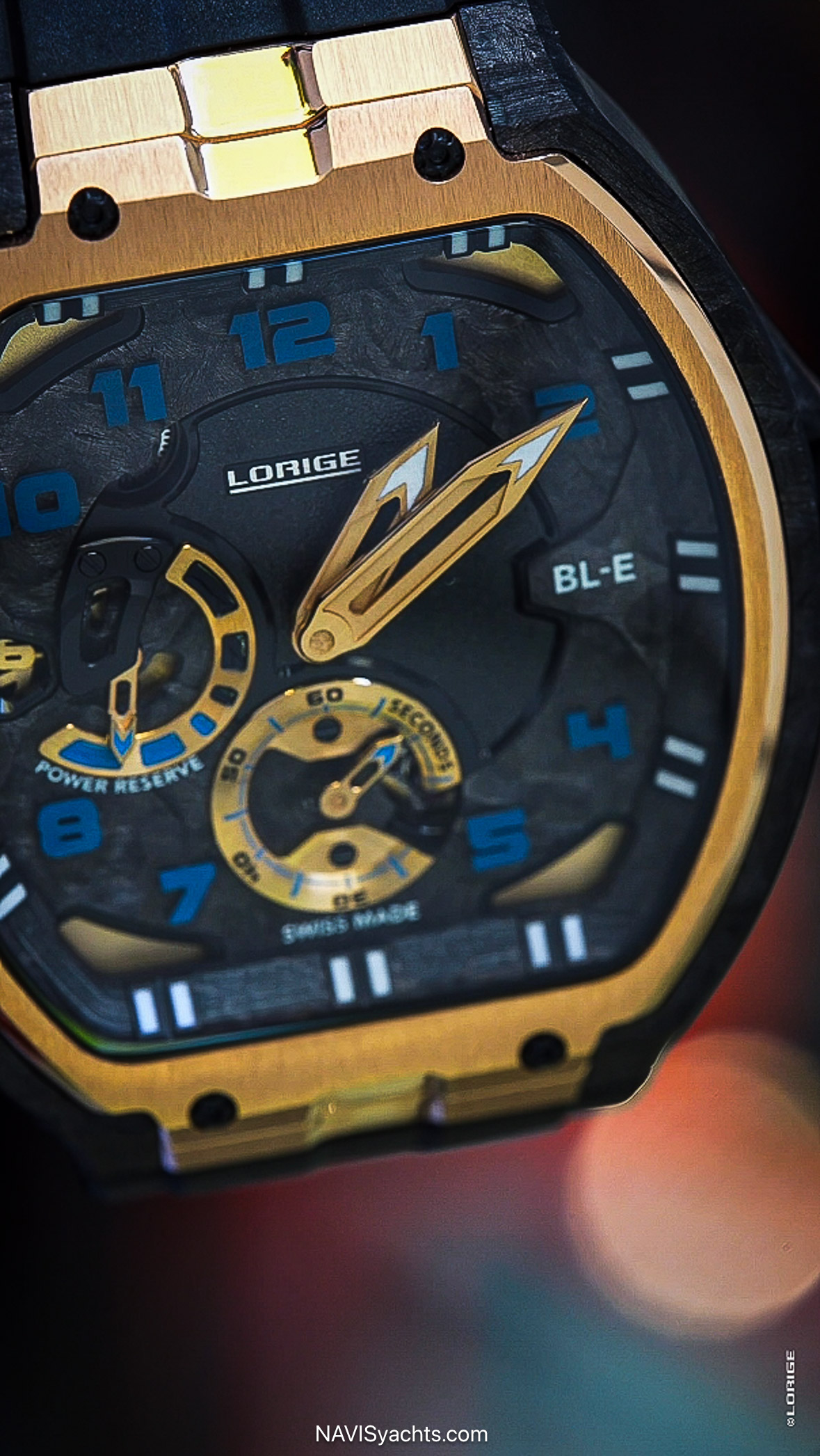
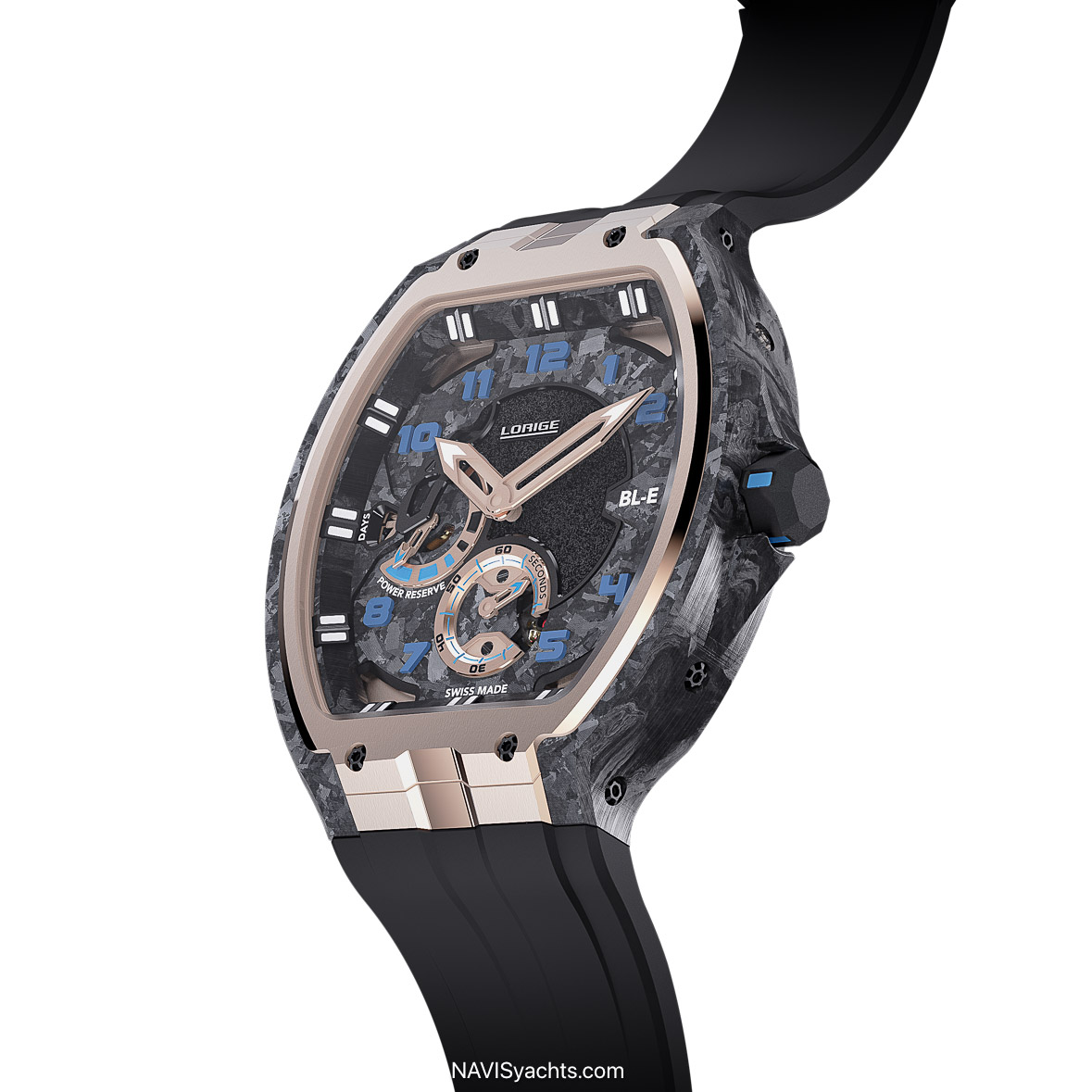
With the Gold Edition, Lorige introduces 5N rose gold to the bezel and caseback, changing the visual character of the BL-Evolution without abandoning its established design. The warm metallic surfaces frame the dark, textured Carbon/Carbon, allowing the contrast between materials to become the principal aesthetic feature. Bleu Asphalte lacquer accents, inspired by the livery of the Heart of Racing Valkyrie, provide a further connection to the car from which the material originated.
The case measures 50 by 42 mm, with a thickness of 10.30 mm. Its elongated proportions give the watch a distinctive architectural presence, while the relatively restrained thickness helps balance its substantial dimensions. Blue Neoralithe Arabic numerals and white Super-LumiNova introduce functional legibility into the composition, complemented by a Carbon/
Carbon dial that continues the material language of the exterior. A black DLC-coated grade 5 titanium crown and a rubber strap complete the design, maintaining its technical character despite the introduction of precious metal.
Perhaps the most successful aspect of the exterior is the treatment of the Carbon/Carbon itself. Its uneven patterns and variations in tone remain visible, creating a surface that changes in character across the case. Against the precisely defined geometry and reflective qualities of the rose-gold components, these irregularities become particularly expressive.
The combination gives the watch a visual depth that would be difficult to achieve with a uniformly finished material.
Seven Days of Mechanical Autonomy
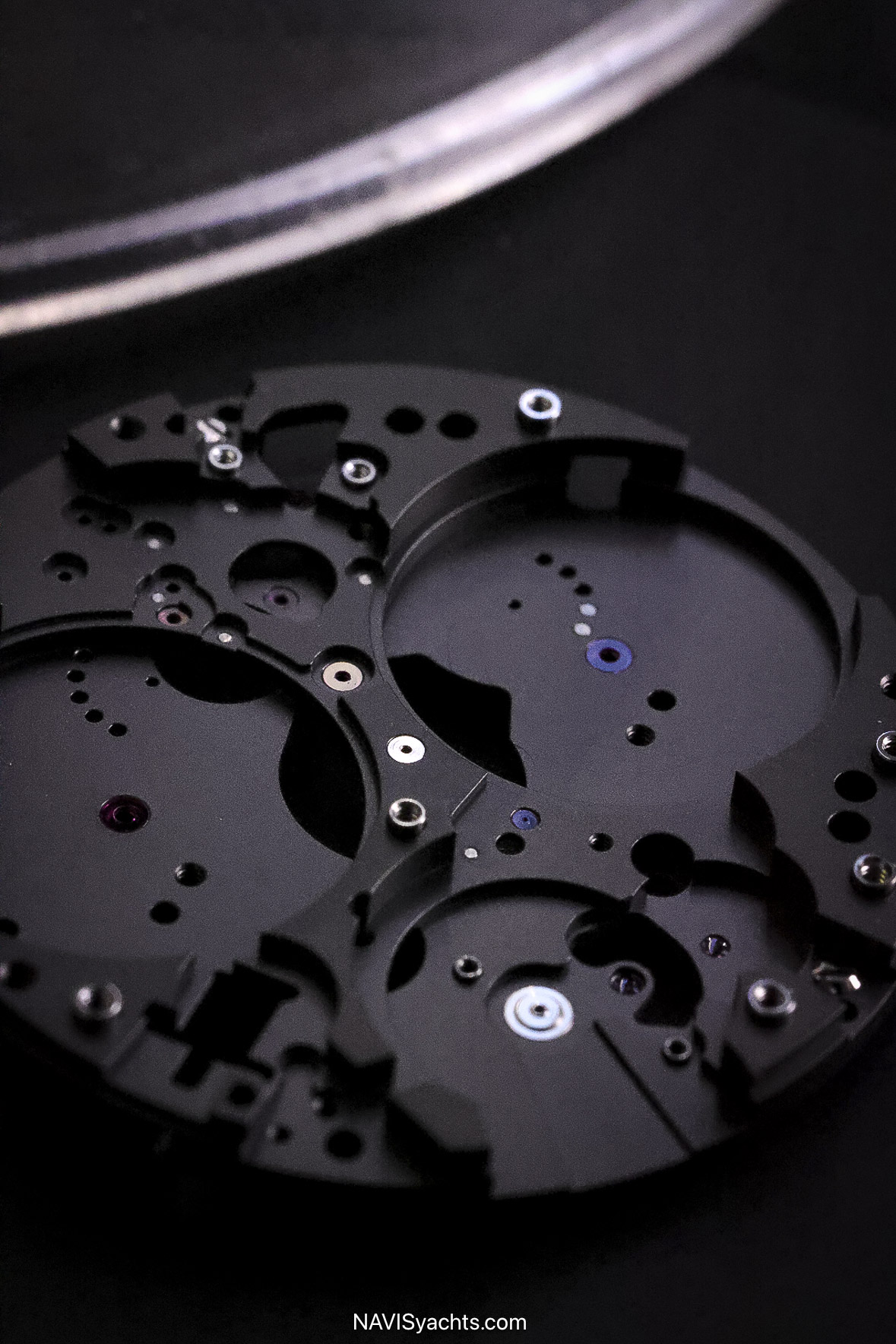
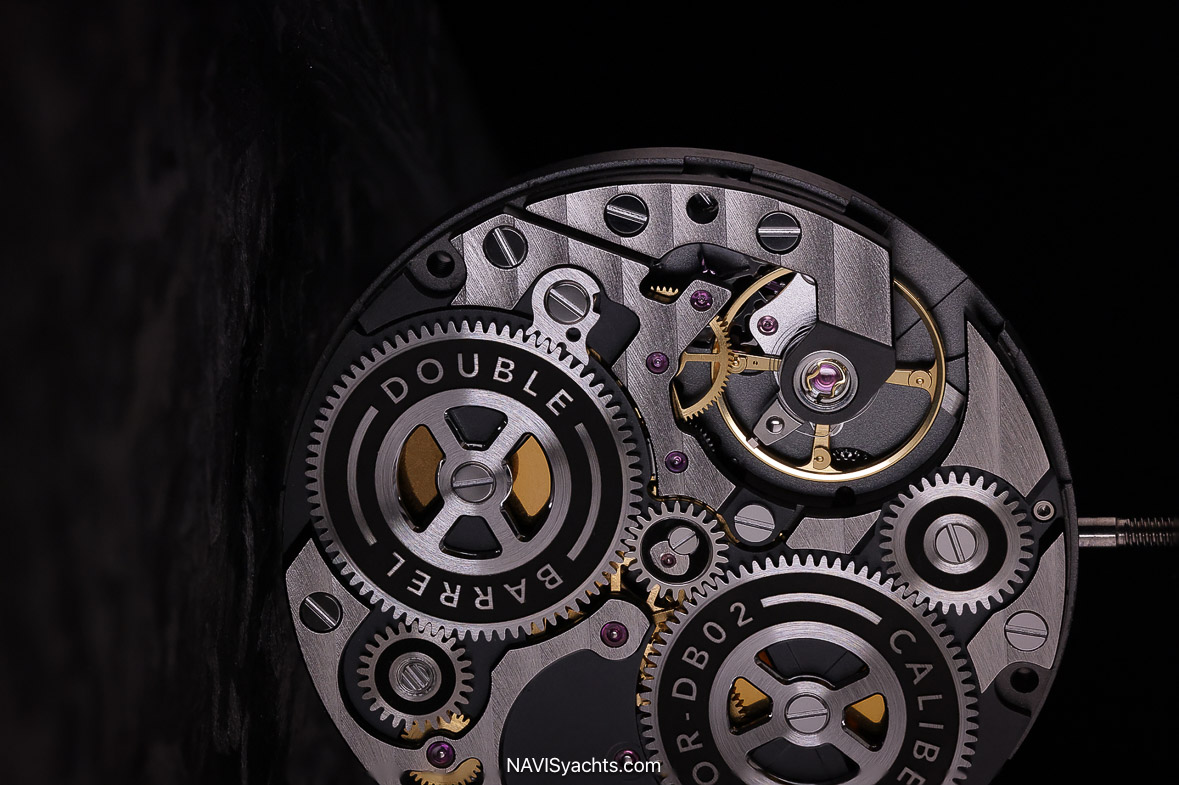
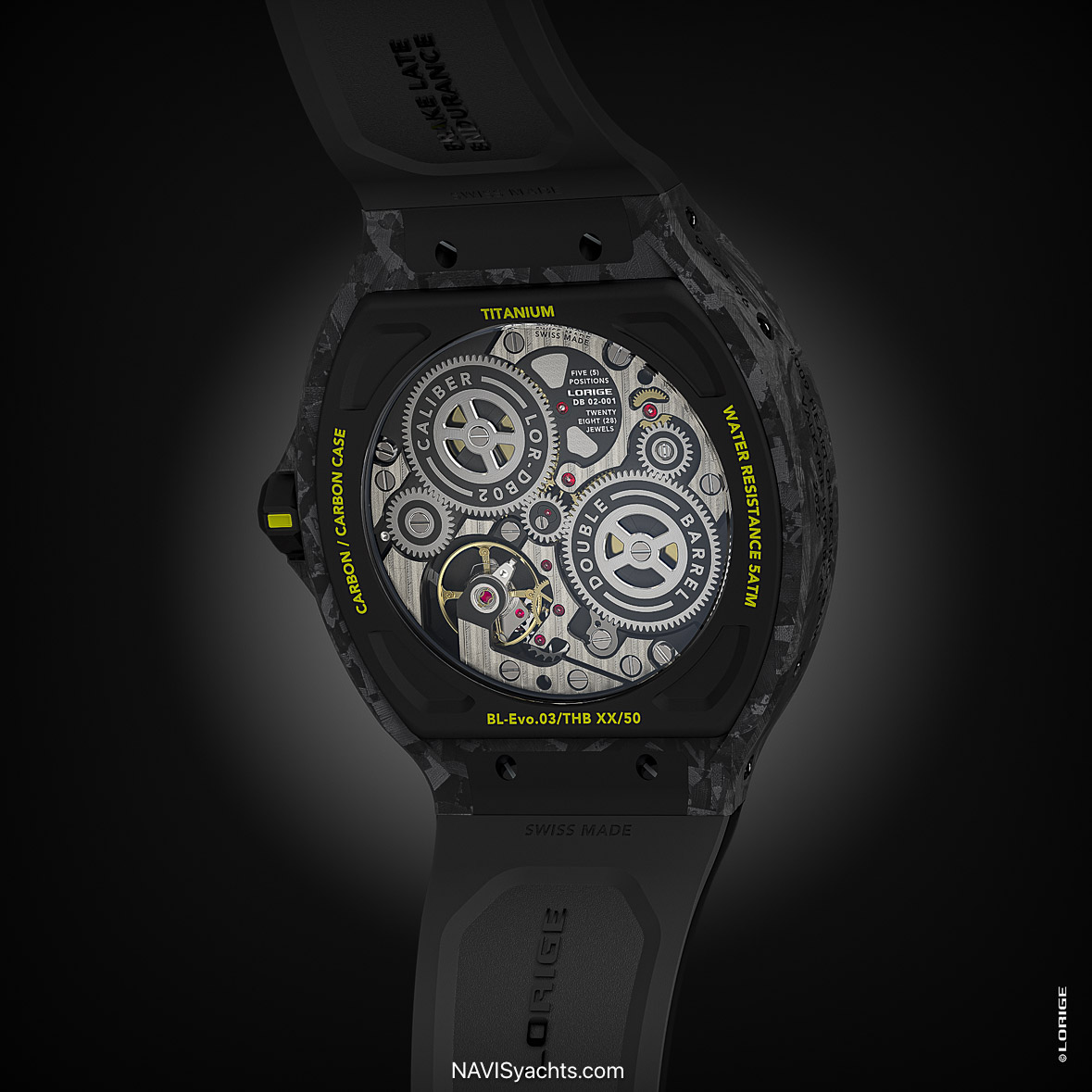
Inside the Bleu Asphalte Gold Edition operates Lorige’s manually wound LOR-DB02 caliber, comprising 175 components and 29 jewels. Its double-barrel architecture provides an impressive 168-hour power reserve, allowing the watch to operate for an entire week between windings. The two mainspring barrels store the energy introduced through the crown and release it progressively to power the movement. A power reserve indicator allows the wearer to monitor the remaining autonomy, while a dynamometric crown forms part of the winding system.
Operating at 21,600 vibrations per hour, or 3 Hz, the movement combines its extended power reserve with compact dimensions of 31.10 mm in diameter and just 3.98 mm thick. The frequency reflects a considered balance between the demands of mechanical timekeeping and the energy available from the mainsprings. The caliber is assembled by hand in La Chaux-de-Fonds, Switzerland, reinforcing the connection between Lorige’s unconventional material engineering and traditional Swiss watchmaking.
For the Gold Edition, the LOR-DB02 receives a distinctive Duo-Tone finish. Microblasted black PVD mainplates and bridges provide a subdued background for rhodium-plated Geneva stripes and manually executed chamfering. The contrasting treatments emphasize the geometry of the components, creating a visual relationship with the dark Carbon/Carbon and rose-gold architecture of the exterior. These decorative techniques also demonstrate the attention devoted to details that contribute little to mechanical performance but considerably to the character of a fine watch.
A Different Expression of Heritage
Limited to just ten examples, the Bleu Asphalte Gold Edition demonstrates how Lorige is developing its identity beyond the novelty of using race-worn materials. The introduction of precious metal gives the BL-Evolution a more sophisticated appearance, while the seven-day LOR-DB02 caliber provides a mechanical achievement worthy of attention in its own right.
For collectors familiar with the engineering of high-performance automobiles, the attraction extends beyond conventional notions of exclusivity. The material has a traceable connection to a particular racing machine and an event in which its performance mattered. Its transformation into a watch preserves that history in an entirely different form.
There is a pleasing irony in taking material once engineered to slow a racing car traveling at extraordinary speed and using it to house a mechanism dedicated to measuring time. With the Bleu Asphalte Gold Edition, Lorige has given that idea an elegant expression, allowing the history of the racetrack to remain visible beneath the refinement of fine watchmaking.
Photos: Lorige Media | Words: Pablo Ferrero