
Reinventing Performance for the Hybrid Age
The LM002 solved the problem of mass with displacement, ground clearance, and a V12 borrowed from the Countach. Four decades later, the Urus SE Performante attacks the same enemy with a denser arsenal: turbocharging, electrification, variable torque distribution, rear-wheel steering, predictive braking and air suspension capable of changing both spring stiffness and damper behavior.
The resemblance lies in Lamborghini’s stubborn refusal to build an ordinary SUV. Performante raises a question.

On the Huracán, the badge evoked lightness and aerodynamic efficiency. The first Urus Performante followed that philosophy, losing weight and replacing adaptive air suspension with rigid steel springs. The new Urus SE Performante moves in the opposite direction. It is a heavy plug-in hybrid with a homologated curb weight of 2,473 kilograms (5,452 pounds), even after carbon-fiber panels, a titanium exhaust and lighter interior materials remove a modest 32 kilograms (71 pounds) from the regular Urus SE. The arithmetic cannot be escaped. It can only be managed.
Lamborghini gives it a formidable 812 CV (801 mechanical horsepower) - and a claimed weight-to-power ratio of 3 kilograms per CV (6.8 pounds per horsepower). A lower ratio means each unit of power has less weight to move. The more revealing change is a sophisticated electronic nervous system designed to anticipate motion before conventional stability control would react. Here, Performante describes control over mass as much as reduction of it.
The Urus concept appeared in 2012 and production began in 2017. The S and Performante arrived in 2022; the plug-in-hybrid SE followed in 2024 as part of Lamborghini’s Direzione Cor Tauri electrification strategy. This flagship Performante crowns the range with a chassis engineered around faster responses.
Its natural setting may be a winter journey rather than a racetrack. Picture a departure from a hotel in Gstaad or St. Moritz: the Urus leaves in electric silence, luggage beneath the rear glass and four occupants sheltered from the cold. The motorway calls for refinement; the final climb brings tightening bends, frost-scarred asphalt and deep snow. This hypothetical route explains the brief. A capable winter traveling car must cover distance calmly, carry people and equipment, then remain predictable as grip and weather change.
Two power sources, one intention
At its center is a 3,996 cc (244 cubic inches) twin-turbocharged V8 producing 620 CV (612 horsepower) and 800 Nm (590 pound-feet). Torque, measured in newton-meters, is the twisting force responsible for the immediate shove felt under acceleration. A permanent-magnet electric motor contributes up to 141 kW (189 horsepower) - approximately 192 CV - and 483 Nm (356 pound-feet). Lamborghini rates the complete system at 812 CV (801 horsepower) and 1,000 Nm (738 pound-feet).
Hybrid output cannot always be calculated by adding the two power figures. Engine and motor may peak at different speeds and under different conditions, so the official number reflects the complete system’s calibration.
The electric motor sits upstream of the eight-speed automatic transmission. Both power sources therefore act through the gearbox and all-wheel-drive system. The motor can sharpen response before the turbochargers produce full boost, smooth gear changes, propel the vehicle on its own, and recover energy during deceleration.
Torque passes through an electronically controlled center clutch that varies power between the axles. An electronic rear differential uses torque vectoring - sending different amounts of drive to the rear wheels - to help the Urus rotate through a corner. Lamborghini describes “on-demand” oversteer, meaning the rear can be encouraged to step outward under power. That remains a manufacturer claim rather than an independent driving conclusion.
Energy comes from a 25.9 kWh lithium-ion battery beneath the load floor and above the rear differential. Kilowatt-hours measure stored energy, much as liters describe fuel in a tank. Lamborghini quotes over 60 kilometers (37 miles) of electric range and an electric maximum speed above 130 km/h (81 mph). The location preserves luggage space and keeps a major mass low in the body. The 54:46 weight distribution means 54 percent rests over the front axle and 46 percent over the rear.
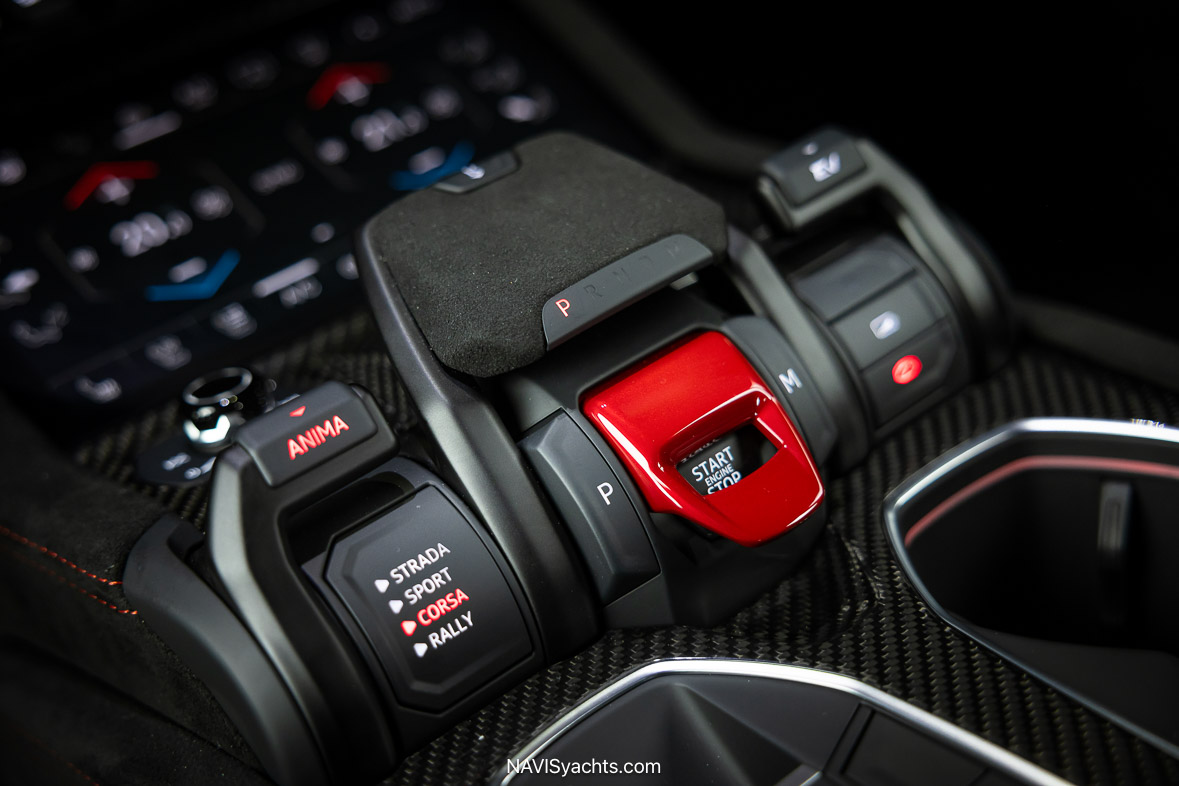
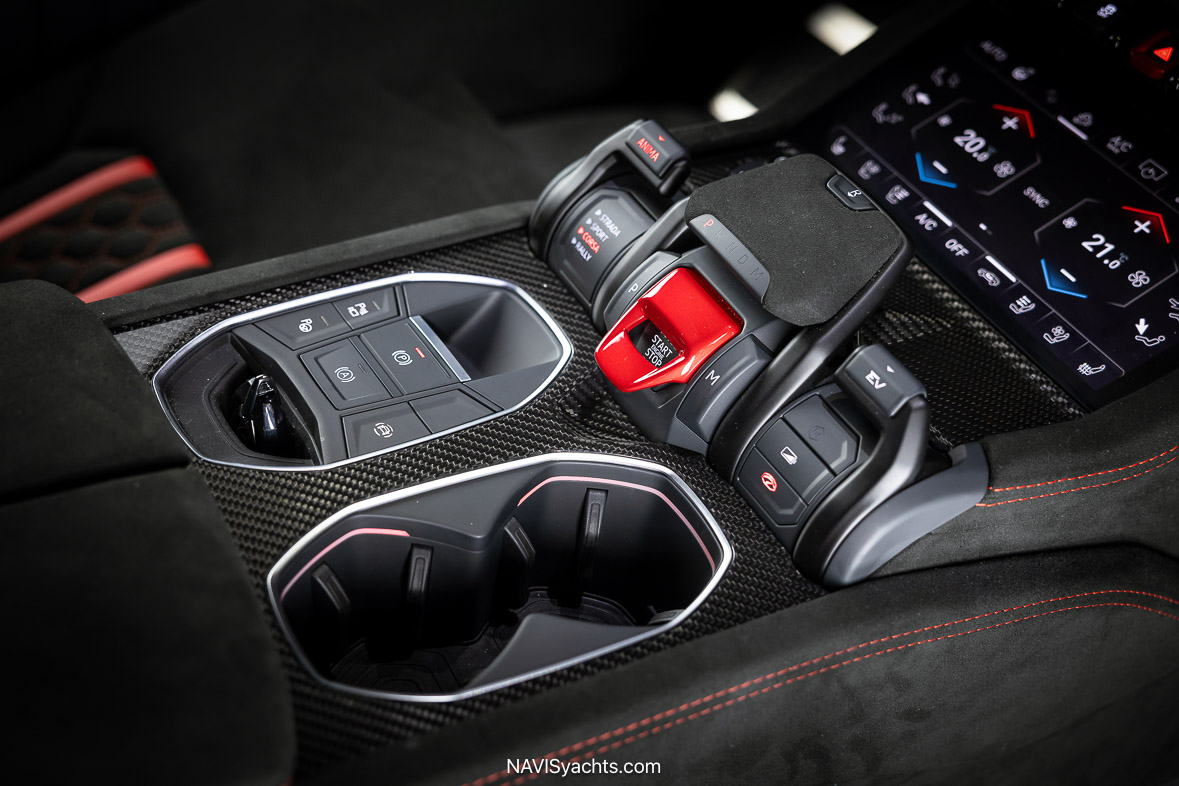
EV mode suits silent urban driving; Hybrid balances the two power sources; Recharge can replenish the battery to 80 percent using the engine; Performance keeps the system ready to deliver its maximum capability. These strategies operate alongside Strada, Sport, Corsa and Rally chassis modes.
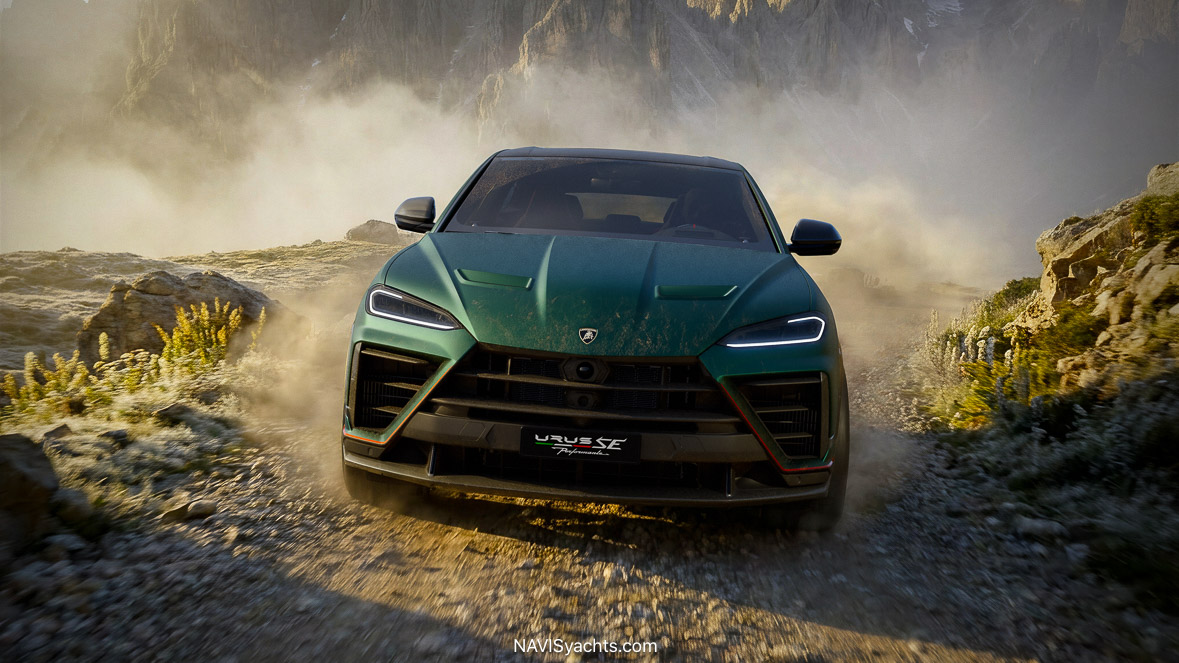
Rally is the newcomer. Its calibration coordinates suspension, hybrid torque, center clutch, rear differential and predictive controls for gravel, dirt and other low-grip surfaces. It permits greater rotation and controlled oversteer, then uses sensor data to keep those movements progressive. It is less concerned with eliminating yaw - rotation around the car’s vertical axis - and more interested in shaping it.
Lamborghini claims 0-100 km/h (0-62 mph) in 3.3 seconds, 0-200 km/h (0-124 mph) in 10.8 seconds, and a maximum speed of 312 km/h (194 mph). At this level, launch performance depends as much on traction, tires, and software as additional horsepower. Fuel consumption and emissions figures remain under homologation; do not apply the published WLTP data for the regular Urus SE to this model.
Engineering and design for the winter road
The previous Urus Performante used steel springs, sacrificing height adjustment and some comfort range for a fixed, focused setup. The SE Performante introduces Lamborghini’s AURA 2K2V air suspension: two air chambers and two damper valves at each corner.
With both chambers connected, the larger air volume creates a softer response for broken roads and long journeys. Closing the connecting valve reduces that volume and increases spring stiffness for tighter body control. Separate valves manage compression and rebound independently. In simple terms, the spring supports the body; the damper controls how quickly it moves and settles.
Lamborghini says the system reduces roll gradient - how much the body leans as cornering force builds - by 55 percent and comfort-related vibration by 25 percent compared with the previous Performante. The test conditions have not been published, but the mechanism explains how one suspension can offer both compliance and precision. Rear-wheel steering helps too: the rear wheels turn opposite the fronts at low speed for maneuverability, then in the same direction at higher speed for stability.
A six-degrees-of-freedom sensor near the center of gravity measures acceleration, roll, pitch and yaw. Eight accelerometers compare wheel movement with the body above.
Conventional stability systems react when a car begins to leave its intended path; this one attempts to recognize the movement earlier and prepare its response.
The Integrated Power Brake varies pressure continuously at each caliper. Lamborghini quotes 32.8 meters (107.6 feet) from 100 km/h (62 mph) and less than 130 meters (427 feet) from 200 km/h (124 mph). Carbon-ceramic discs measure 440 millimeters (17.3 inches) at the front and 410 millimeters (16.1 inches) at the rear. How regenerative braking - when the motor returns energy to the battery - blends with the conventional brakes remains unexplained.
Carbon fiber appears in the hood, roof, wheel arches, side skirts and diffuser. The titanium Akrapovic exhaust removes over 10 kilograms (22 pounds); the brake system saves four. These reductions are modest beside the hybrid system’s mass, but weight saved high in the body helps resist lean.
Aerodynamics gives the Performante much of its visual identity. Drag is air resistance; downforce uses airflow to press the car towards the road. Lamborghini reports three percent less drag than the Urus SE, 23 percent greater downforce than that model and 16 percent more than the previous Performante. A new splitter, paired rear spoilers and a large diffuser guide the air. Hood S-ducts, fender outlets and wheel-arch passages extract heat, and a NACA duct sends cooling air towards the brakes.
At 5,117 millimeters (201.5 inches) long and 2,031 millimeters (80.0 inches) wide without mirrors, the Urus does not attempt to look delicate. Its carbon hood rises around a central power dome, giving the driver a visible centreline. An omega-shaped graphic emphasizes width, enlarged intakes expose the cooling demands, and carbon wheel arches frame 22- or 23-inch wheels.
At the rear, an upper wing works with a second spoiler and the largest diffuser yet fitted to an Urus. Hexagonal graphics recall the Countach without turning the design into a retrospective exercise. The drama has technical work to do: release pressure, feed radiators, cool brakes and reduce lift.
Winter changes the way these surfaces are read. Against snow, exposed carbon, dark apertures and the sharp shoulder line become particularly graphic; road grime will cover the lower body within minutes. That is part of the appeal. This expensive design is intended to move through weather, not remain isolated from it.
Dedicated Pirelli P Zero tires account for the hybrid’s torque and weight. For a winter journey, Pirelli Scorpion Winter 2 tires are the relevant option. All-wheel drive can distribute power, but braking and steering on snow still depend primarily on the tire compound touching the road. Wider Bridgestone Potenza Race semi-slicks occupy the other extreme, trading grooves and wet-weather ability for dry circuit grip.
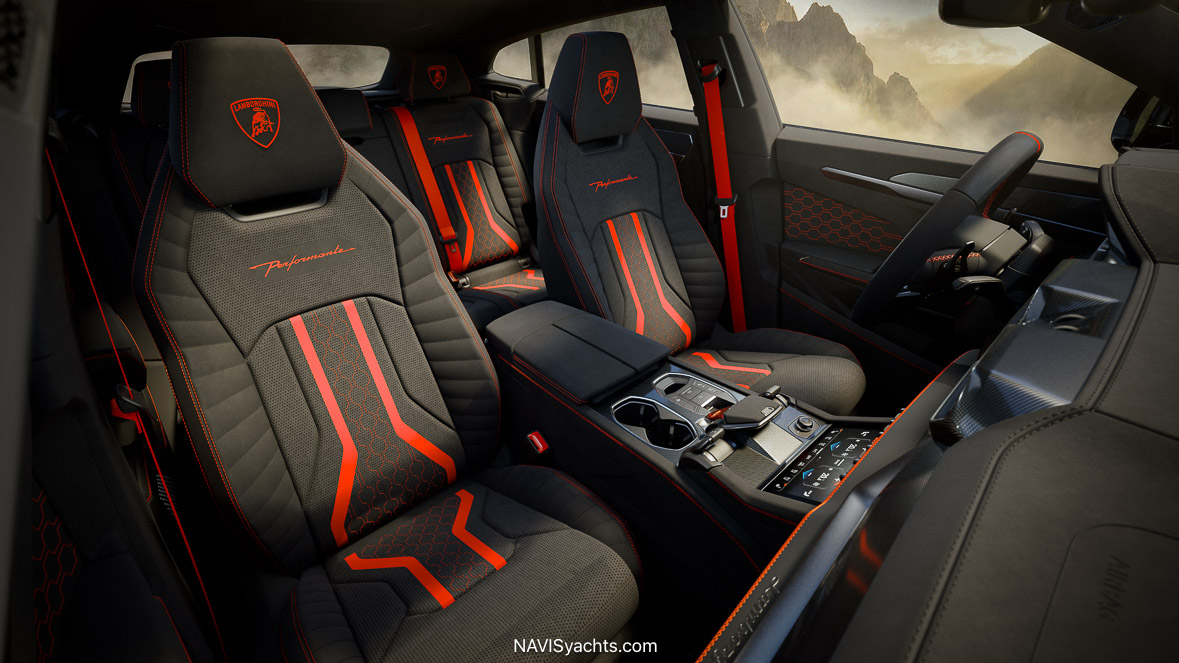
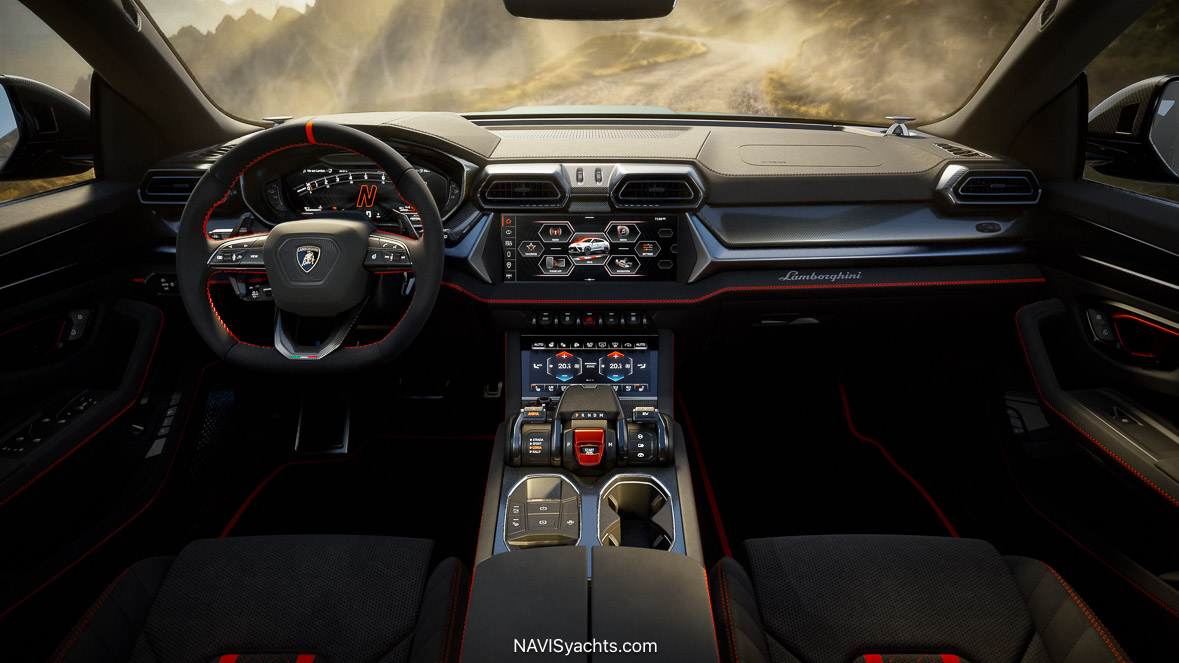
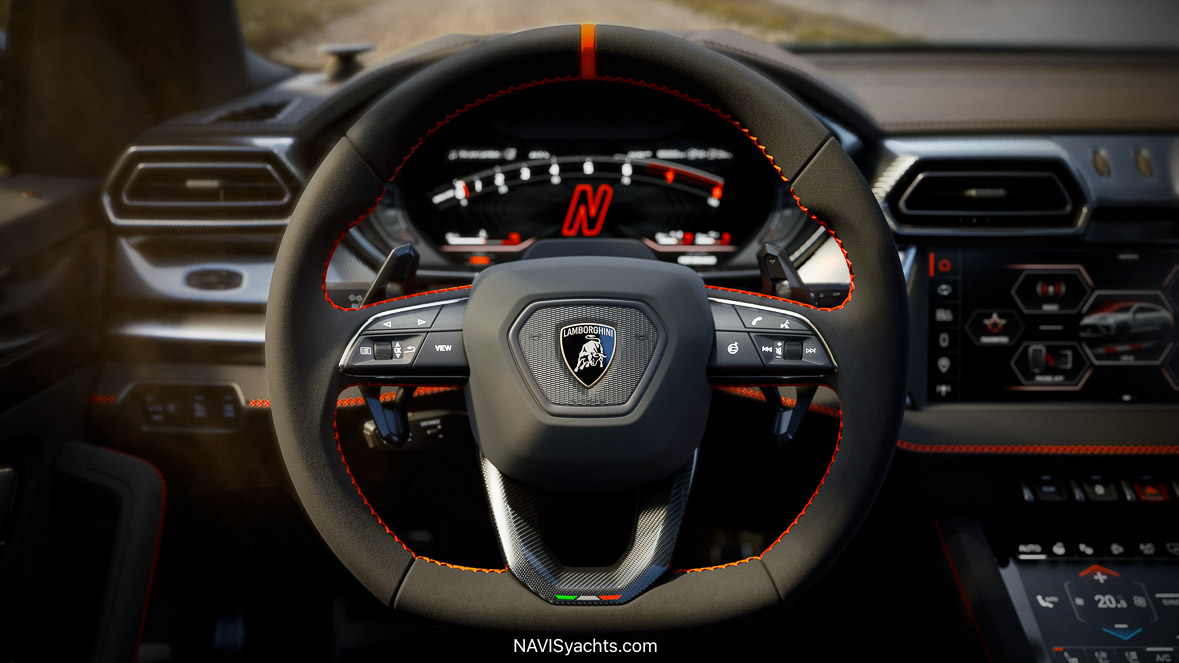
Inside, the elevated seating position should help the driver see along snowbanks and through spray, and the cargo area provides space for winter equipment. CorsaTex by Dinamica, exposed carbon, Y-shaped details and an aviation-inspired switch panel give the cabin its identity. Two 12.3-inch displays carry instruments, navigation, hybrid information and telemetry. Physical controls and the Tamburo mode selector matter because they let the driver adjust the car without searching through menus on an unfamiliar mountain road.
The titanium exhaust completes the sensory design. Independent gas paths for the two cylinder banks and Helmholtz resonators tuned to 124 and 128 Hz reinforce low frequencies while suppressing cabin boom. The V8 flares to 2,400 rpm at startup; its overrun sound changes between Sport and Corsa. In EV mode, it disappears, allowing a winter departure to begin quietly before combustion returns further along the road.
The Urus SE Performante’s identity lies in how tightly its systems are connected. Electricity changes torque delivery, the driveline shapes balance, suspension manages the loads, and aerodynamics extracts heat. Whether that intelligence feels natural requires a proper drive.
The engineering already reveals how Lamborghini has changed the meaning of its most demanding badge. The old Performante sought speed by removing mass. This one accepts mass, studies its movement in six directions, and deploys an entire network to control what happens next. On a winter road, that intelligence may be most valuable when the pace falls, the temperature drops, and certainty matters more than the stopwatch.
The badge once described a lighter Lamborghini. Now it describes a Lamborghini trying to think faster than its weight can move.



Written by Tomas Ferrero - Photographed by Lamborghini media