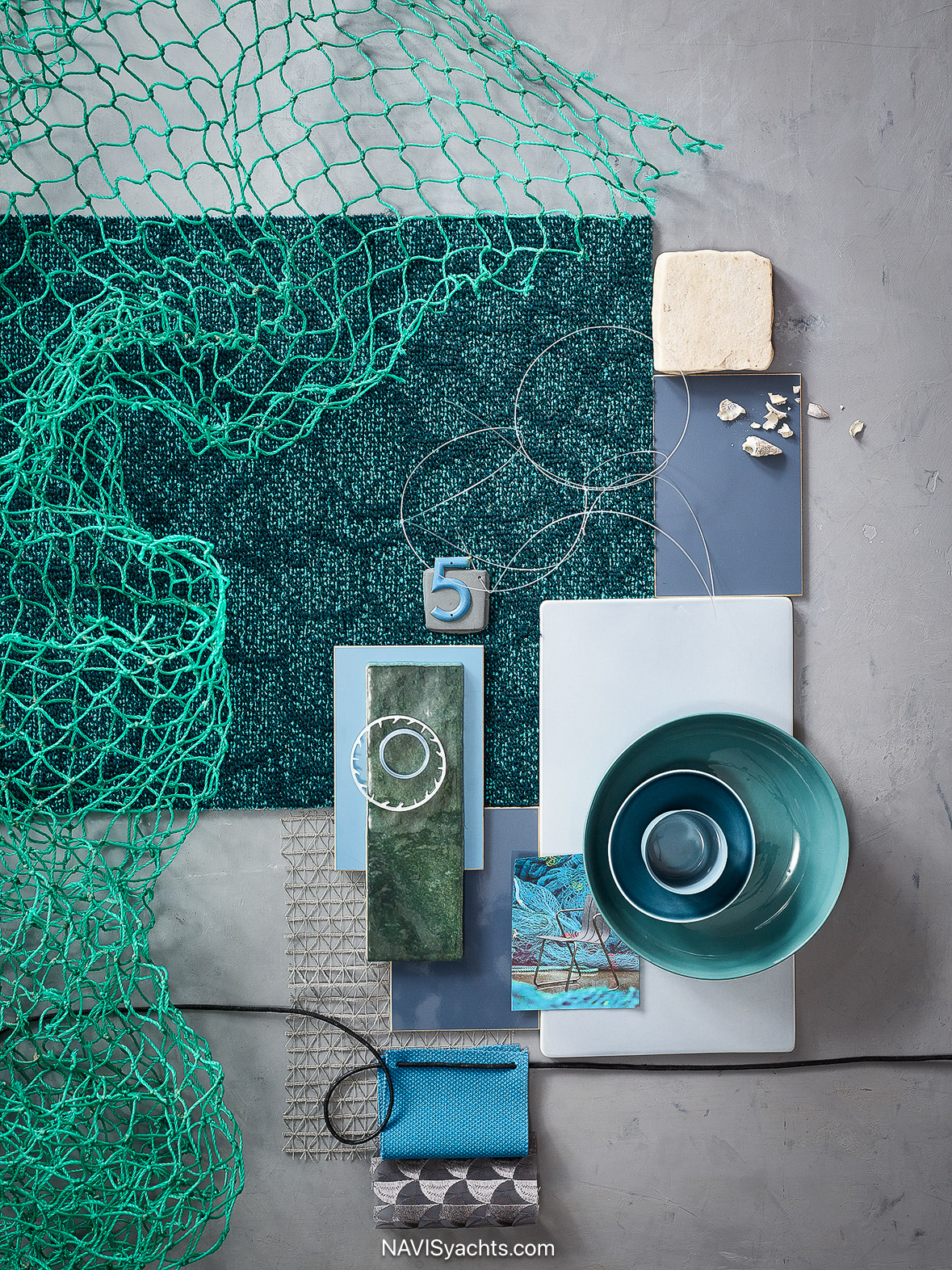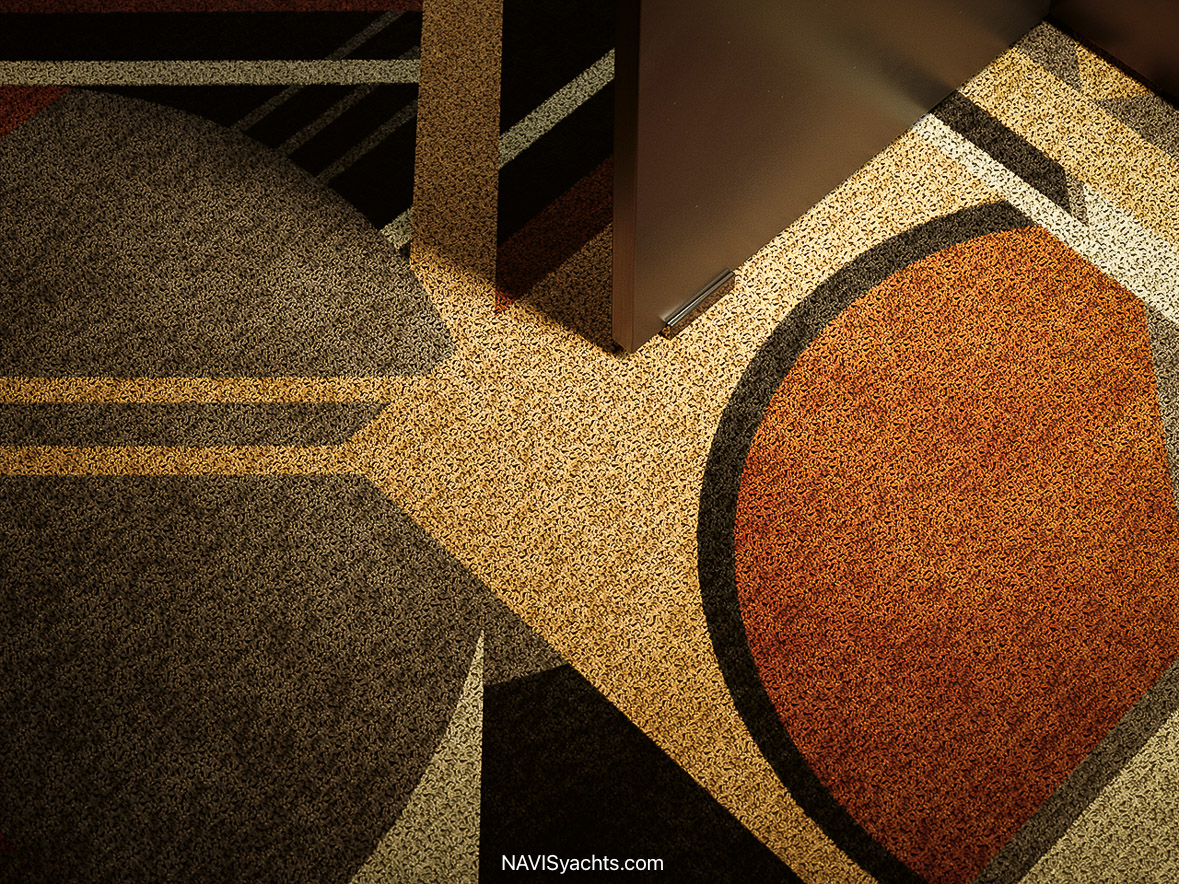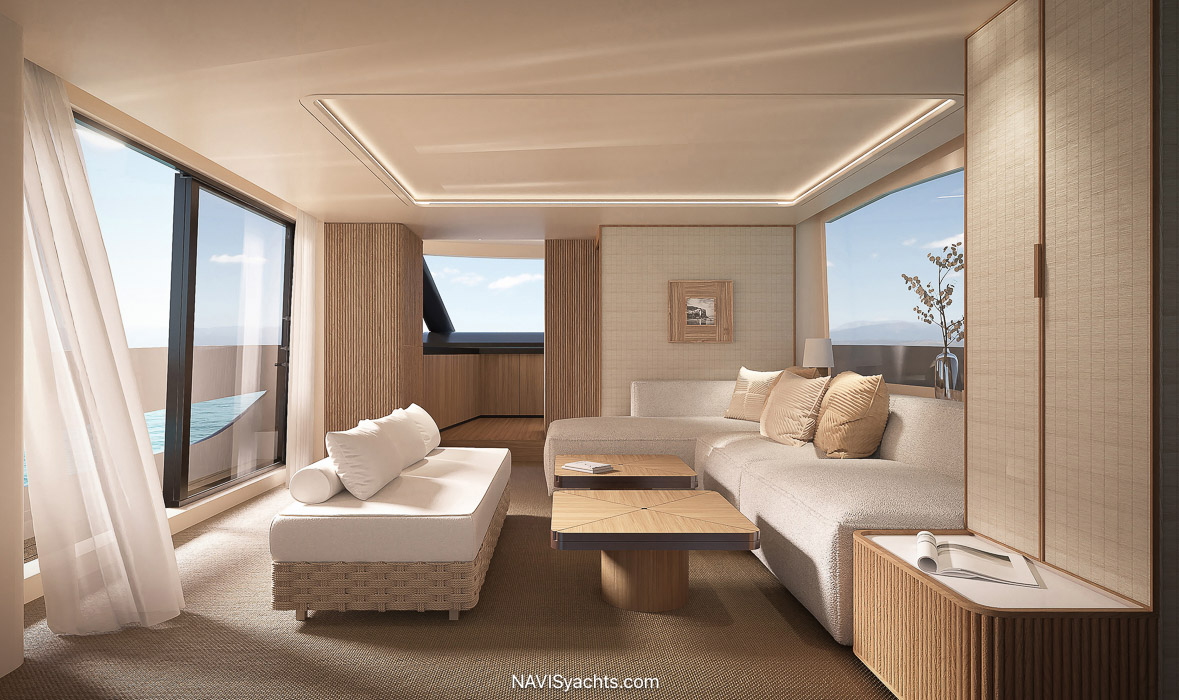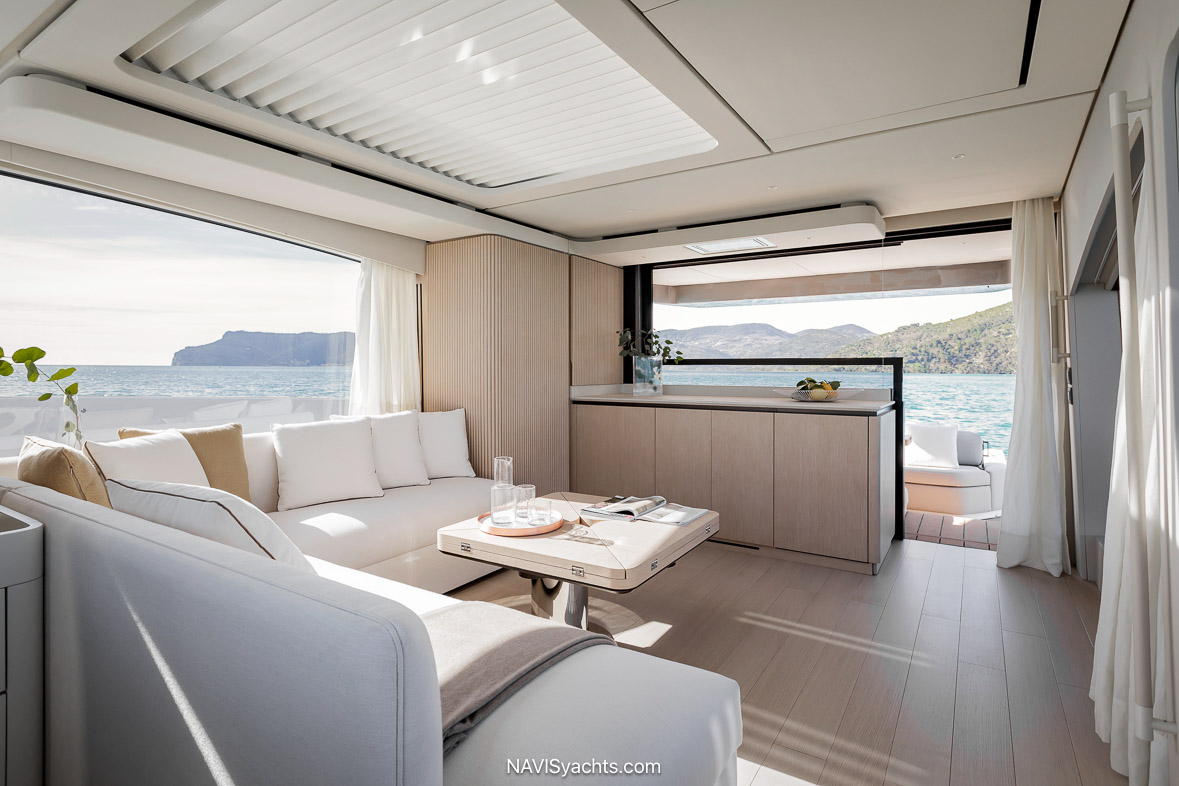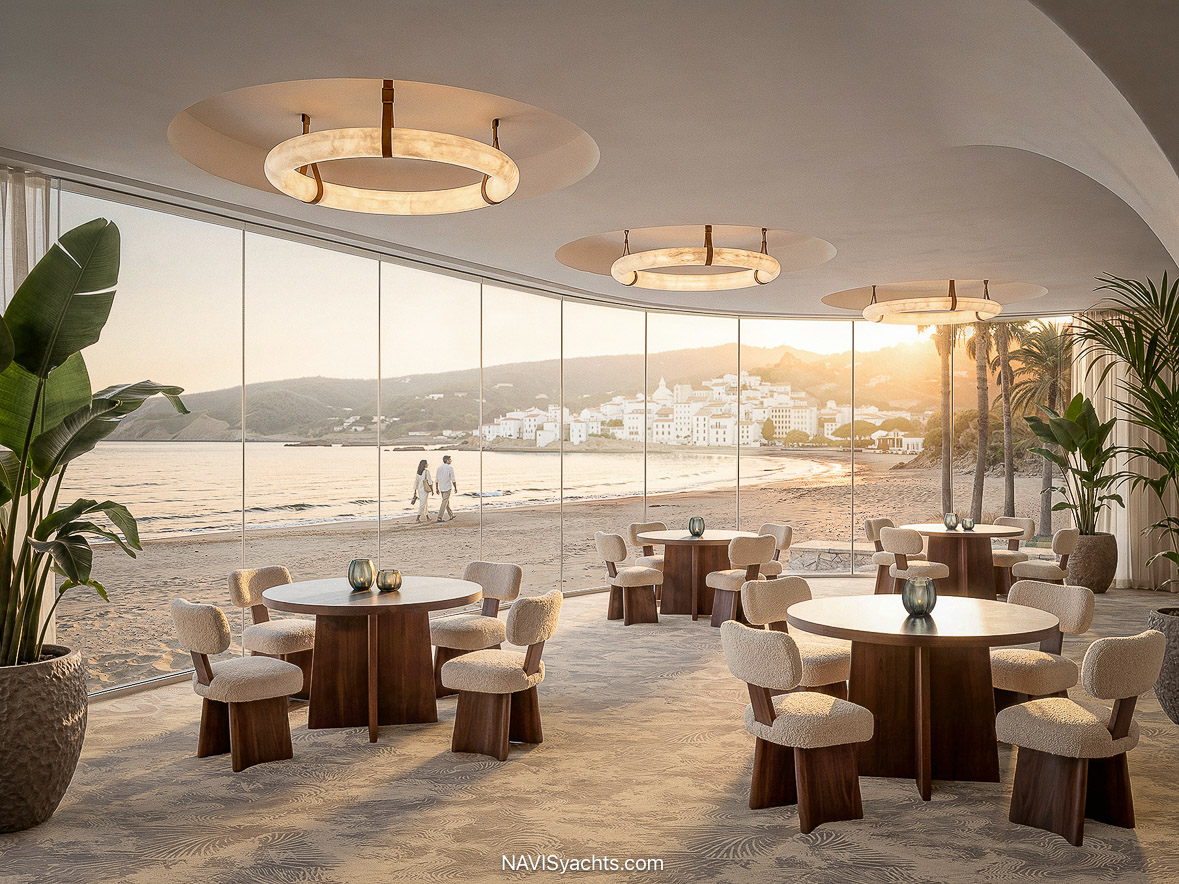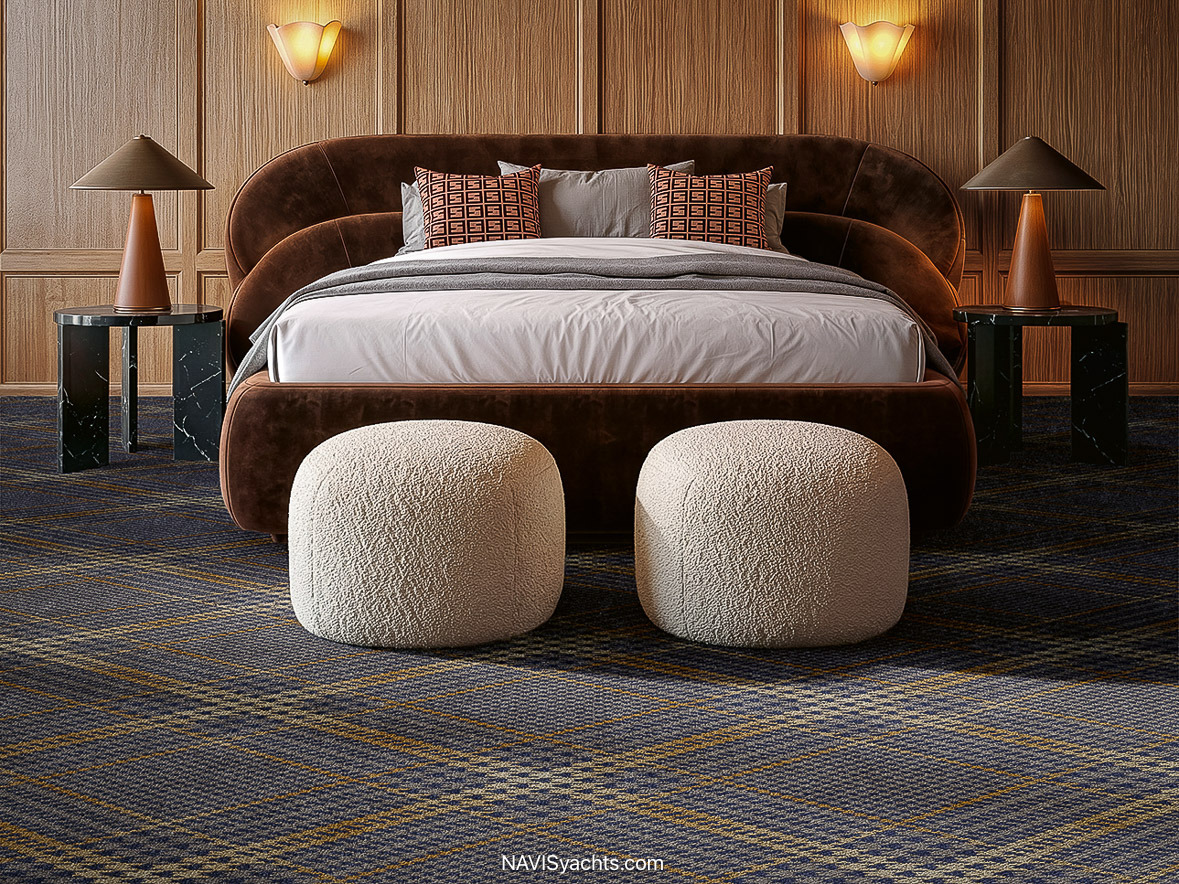
Every yacht enforces one small ritual that almost no house does: at the passerelle, the shoes come off. From that moment on, the floor stops being something you look at and becomes something you feel — the first sensation of the morning, the last one of the night, the surface a barefoot guest reads more closely than any wall, fabric, or finish on board. Ashore, flooring is judged by the eye. At sea, it is judged by the skin.
That simple fact changes everything about how a carpet for a yacht should be conceived. It explains why the finest interiors treat the floor not as a background but as an instrument — tuned for touch, sound, light, and longevity in one of the most demanding environments a textile will ever serve.
The Meaning of Bespoke
“Bespoke” is one of the most used words in yachting, and one of the least understood. Choosing a color from a catalog is not bespoke; it is selection. There are makers who treat customization as garnish — a stock design trimmed to size — and there are makers who treat it structurally. A truly bespoke carpet begins with a single room on a single vessel and is conceived for nothing else.
That starts with geometry. Few rooms at sea are rectangular. Bulkheads curve with the hull, staircases spiral, furniture is fixed, and thresholds are measured in millimeters. A bespoke floor answers that geometry directly: rugs are made to measure, cut to the exact shape of the space and finished with individually chosen borders — the binding itself becoming a design element, tracing a saloon’s curve like a coachline — while wall-to-wall carpet is planned to the room’s template so the pattern sits exactly where the designer intended. A motif is not simply repeated across a floor; it is composed within the room’s contours.
Then comes color — and color at sea behaves differently. Interiors are lit by water-reflected daylight through expansive glazing by day and by carefully layered artificial light at night. Serious makers therefore develop color for the project itself: colorways are tuned, strike-off samples are produced, and the decisive judgment is made under lighting that matches the yacht’s own. A tone that looks perfect in a showroom in northern Europe can drift noticeably at anchor in the Bahamas. Craft means anticipating that.
Finally, construction. Pile fiber, pile height, density, backing — each is chosen for how the room will actually be used. A full-beam owner’s suite asks for a different build than a stair, a dining saloon, or a corridor walked by crew a hundred times a day. This is the real meaning of bespoke: not decoration applied to a floor, but a floor composed for a life on board.
The Materials
Every fiber is a decision whose consequences reveal themselves over years.
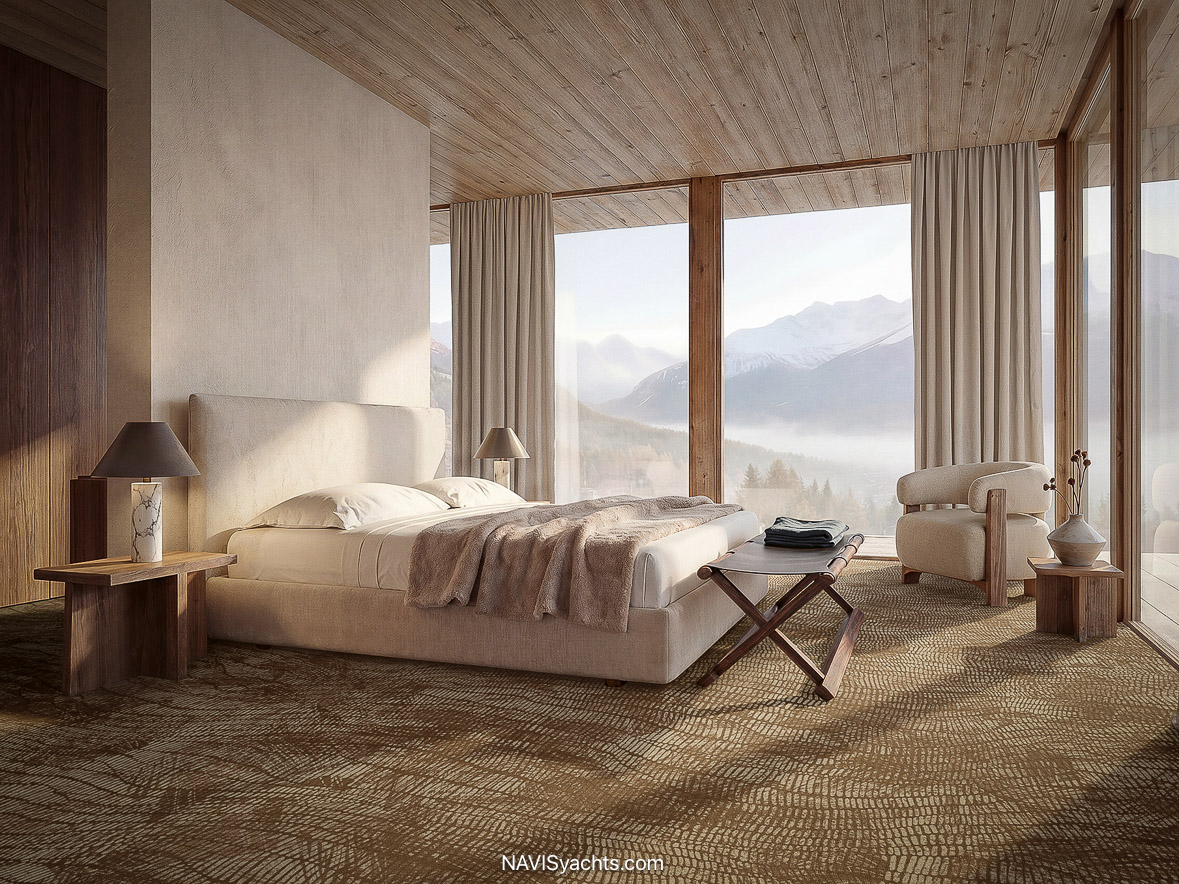
Wool remains the classic for good reason. It recovers from crushing, buffers humidity, ages gracefully, and is naturally reluctant to burn, a quality the marine world has always valued. Silk and lyocell bring luster and a finer hand, usually as accents where glamour outweighs traffic. And modern premium polyamide and polyester have earned its place on board: engineered for resilience in the hardest-working interiors, it holds its structure in corridors and stairs where natural fibers tire, and it takes color with unusual depth.
How that color arrives matters more than most owners suspect. Yarn can be dyed before it is tufted; the finished carpet can be dyed as a whole — piece-dyeing, which lets a maker develop the exact tone for one project rather than selecting from a standard yarn program; or the design can be printed in high definition onto the finished construction, a discipline of its own. For bespoke work, the latter two are where the freedom lives. What counts at sea is the proof behind the method: light- and colorfastness tested to the standards of demanding contract interiors, because under floor-to-ceiling glass, a carpet receives more sun than most living rooms ashore.
Two quieter parameters matter as much as the fiber. The first is density: a dense, well-anchored pile of moderate height will outlast — and outclass — a tall, sparse one, holding its geometry where footfall concentrates. The second is weight. On a vessel, every material is part of a larger calculation of displacement and build-up height, and a carpet engineered for demanding use respects both.
All in all carpets are very resilient and the perfect solution for a sensitive feeling under the feet.
Besides indoor usage some carpets are developed for outdoor, for areas on the deck. The specific outdoor carpets are easy to clean, dry quickly and are water- and UV-resistant, so they can easily withstand outdoor conditions.
The Making
The craft spans centuries, from hand-knotting, where artisans build a piece thread by thread over weeks, to the discipline behind most of today’s finest interior textiles: precision tufting. In tufting, thousands of needles set yarn into a backing at exactly controlled density and pile height, producing the dense velours, silken loops, and sculpted high-low structures that give a modern carpet its depth. Density is the quiet measure of quality here: it decides how a surface feels underfoot on day one and how it still looks in year ten.
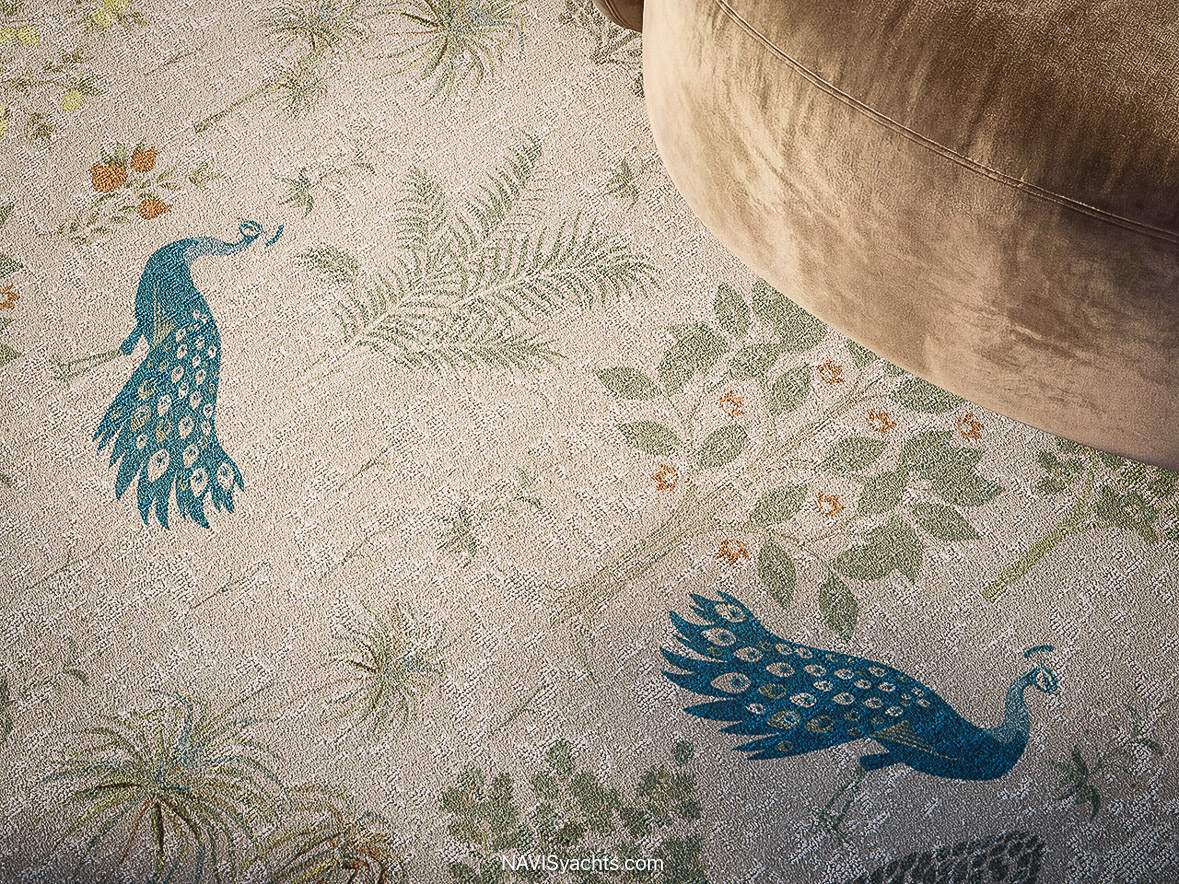
On these constructions sits the layer where bespoke truly happens: design. High-definition printing onto dense velours and loops renders painterly gradients and fine drawing with a clarity that was impossible a generation ago, and makes every surface individual without sacrificing performance. A motif can be developed for one owner, one room, one light, and carried consistently across the large connected areas a yacht interior demands. The same logic extends to rugs made entirely to measure: cut to the room’s exact geometry and finished with individually selected borders, so that even the edge of the floor is a decision, not a default.
What holds it all together is process. A serious commission moves through visualization, physical sampling, and approval before final production begins. And it relies on a craftsman’s eye for details an owner may never consciously notice but will always subconsciously feel: pile direction kept consistent so the surface reads calmly in raking light; patterns aligned precisely across a stair; the knowledge that a glossy velour changes tone with every viewing angle, while a matte construction holds one quiet note.
The Invisible Engineering
A yacht is, among other things, a machine — engines, generators, air handling, water moving along the hull. Hard surfaces reflect that energy; textile absorbs it. In an interior of glass, lacquer, and stone, the carpet is usually the largest acoustic device on board, shortening reverberation, softening footfall between decks, and creating the particular hush that guests register as serenity without ever asking why. It is no coincidence that classification societies now publish comfort-class notations for noise and vibration: quiet has become a measurable dimension of luxury, and the floor is central to achieving it.
The second invisible discipline is safety. Fire behavior is engineered into a serious textile floor long before anyone discusses it, in the choice of fiber and in dense constructions tested to recognized flammability standards. At sea the governing regime is the IMO FTP Code, Part 2, with EU-flagged vessels certified under the Marine Equipment Directive; ashore, the comparable benchmark is EN 13501-1. What a given vessel formally requires then depends on how she is flagged and used, and is settled between owner, designer, and shipyard early in the specification. The third is air. A yacht interior is a sealed, conditioned space, so low-emission materials matter more than they do ashore, and a fine textile floor quietly helps, binding dust at the surface until it is vacuumed away instead of leaving it circulating at breathing height.
None of this appears in photographs. All of it appears in the experience.
The Circular Question
The environmental conversation in yachting has grown louder, and with it the temptation of comfortable vocabulary. Owners are told that materials are “sustainable”, a word that, on its own, verifies nothing. The craft deserves better questions, and the honest answers are concrete.
The first is longevity itself: the most responsible textile is the one built well enough not to need replacing. The second is material architecture. The most credible advance in flooring today is design for disassembly, constructions deliberately reduced to a small number of main materials, joined so they can be separated again at the end of use and returned into production as raw material. Recycled-content yarns, backings engineered for separation, and manufacturer take-back schemes turn a floor from a future disposal problem into a future material stream.
For an owner or a designer, the test is simple and revealing. Do not ask whether a carpet is sustainable. Ask what it is made of, whether its materials can be separated, and who will take it back. Makers who have done the engineering answer in specifics. Marketing answers in adjectives.
Commissioning Well
For an owner beginning a new build or a refit, a handful of habits separate a good flooring outcome from a spectacular one. Bring the flooring conversation forward; deck build-up heights and acoustic targets are fixed early, and the floor should be designed into them rather than fitted after them. Judge color and texture at full scale and under the right light, ideally on board, never from a small swatch in an office. Ask for the construction in plain terms — fiber, density, backing — and how it will behave under sun, salt air, and years of barefoot traffic. Ask how the crew should maintain it at sea, and what happens to it at the end of its life. Then treat the maker’s reaction to those questions as part of the specification: true craftsmen enjoy them, because the answers are where the craft actually lives.
The truth about a great yacht carpet is that it refuses to stay in the background. It is the warmth underfoot at six in the morning and the reason the saloon sounds calm with twelve guests in it, but when design and touch are conceived with real intention, it becomes the room’s center of gravity: the surface guests kneel to run a hand across, the pattern that anchors everything placed upon it, the detail people mention when they describe the boat. Barefoot, at sea, the floor is not the background of an interior. It is its most intimate stage — the one element every guest is in touch with from the first step aboard to the last.